

It never gets the headline. No customer buys a deodorant or a body butter because the label says tapioca starch, and that is exactly why founders mishandle it. Tapioca starch is treated as a filler to pour in until a formula feels drier, smoother, or less greasy — and then the product turns chalky, drags on skin, pills under friction, or separates because a powder was asked to do a structure's job. The disappointment is quiet, but it is fatal: the product feels cheap in the first ten seconds.
Used at the right level, for the right job, tapioca starch is one of the most useful texture tools in body care. It absorbs surface oil, softens greasiness, and gives powders and sticks a smoother glide — without needing a treatment claim to justify its place.
What tapioca starch actually is
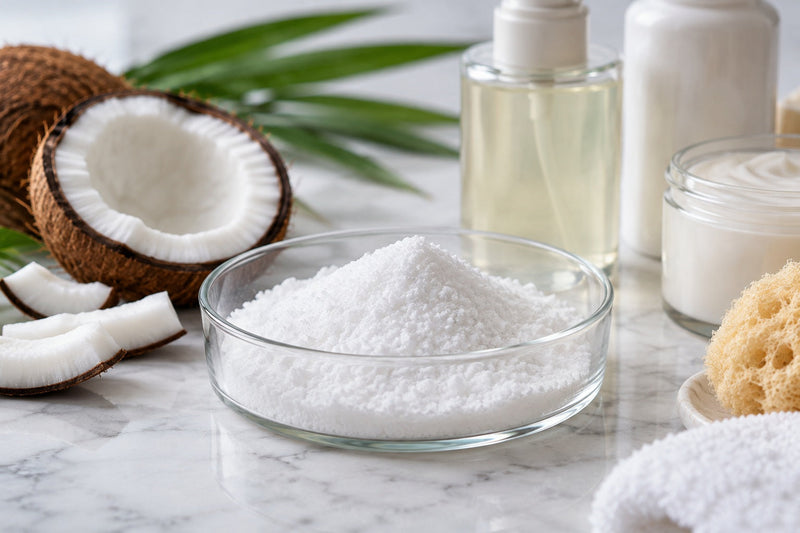
On a cosmetic label, tapioca starch appears as Tapioca Starch. It is a plant-derived starch from cassava root, supplied as a fine, soft powder. Some cosmetic grades are modified or blended for better oil absorption, flow, or skin feel — specify the grade you are using and label from that specification, because "tapioca starch" on a purchase order can cover materials that behave differently in a batch.
Its job is physical, not therapeutic. Tapioca starch absorbs moisture and oil at the surface, changes how a product spreads and sets, and changes what skin feels like a minute after application. It does not treat skin, block sweat, or preserve a formula, and copy that borrows those jobs for it will not survive contact with a real customer or a careful retailer.
Tapioca starch: the decisions that decide the feel
Oil absorption is the headline — in deodorant, butter, and dry formats
In a deodorant stick, tapioca starch helps the surface feel drier after application and can take up some of the moisture that would otherwise make a stick feel wet or slippery. It supports comfort; it is not an antiperspirant, and it does not stop sweat. In a body butter or cream-style product, a careful level can cut the greasy after-feel that makes customers use less and rebuy slower. In dry formats, it is part of the powder phase that keeps the product feeling soft rather than slick.
That range is why founders love it — and why dosing discipline matters. The level that takes the edge off greasiness in a butter is not the level a dry powder needs, and neither transfers automatically to a stick.
Too much is chalk, drag, and white residue
Starch announces its overdose immediately. Too much in a deodorant leaves white marks and a dry drag customers read as low quality. Too much in a body butter turns a rich scoop chalky and can leave skin looking ashy, especially where the base was already matte. Too much in a cream can thicken in the wrong way — pasty rather than cushioned — and still not give the emulsion the stability it actually needs.
The fix is not a better fragrance to cover it. The fix is a specified range, tested on skin at the low and high end, with the finished product checked for residue, glide, and after-feel. If the only test was how the bench sample looked in a jar, the overdose will be discovered by customers.
It is not a thickener, a wax, or a preservative
This is the category error behind most tapioca failures. Tapioca starch can add body to a powder and change the feel of an emulsion, but it does not replace the wax structure that holds a stick, the emulsifier system that holds a cream, or the preservative system that protects a water-based product. In a water-containing formula, starch is also part of the food picture for microbes if preservation is weak — another reason a water-based product needs a dedicated preservative system and efficacy testing, with starch counted as part of the system, not treated as dry and irrelevant because it arrived as a powder.
Heat matters too. Starch in a hot water phase can swell and change viscosity in ways a cold-blended powder does not. The process — when and how the starch goes in — belongs in the batch record, not in habit.

Where tapioca starch earns its place
- Deodorant sticks — for a drier surface feel and smoother glide, with residue tested on skin and fabric.
- Body butters and creams — at a careful level, to reduce greasy after-feel without turning the product chalky.
- Dry and powder-leaning body products — as part of a soft powder phase, with flow and packaging checked for real bathroom humidity.
Stability, storage, and packaging are not footnotes
Starch picks up moisture. Raw material storage, batch-room humidity, and a finished pack that lets bathroom steam in will all change flow and feel over time. Stability testing should check texture, glide, scent, and — in water-based systems — pH and preservation in the real packaging. A product that felt silky at filling and feels gritty or pasty at month three was not finished at filling; it was unfinished and untested.
What to decide before you brief a run
Decide the job first — drier feel, less greasiness, or powder softness — and let that job set the level. Decide the grade second, specified and verified. Decide the process third: hot phase or cold blend, written into the batch record. Test residue and after-feel last, on skin, before the label promises a finish the starch cannot deliver.
Keep reading
- Deodorant Sticks: the daily product that has to work without being noticed
- Body Butter: the rich product customers judge by the first scoop
How we approach it
At Simplicity Filling Systems, a tapioca starch project starts with the job, the grade, and the level side by side, then checks residue, glide, and preservation before any label is printed. As a full turnkey partner, start to sold, we carry ingredient sourcing, manufacturing, bottling and packaging, fulfillment, and website and marketing support — across perfumes, body washes, creams, sugar scrubs, body oils, massage oils, beach body oil, deodorant, body butter, beard oil, and hair oil. Small runs welcome, startups welcome, built to scale. Comparing quotes? Show us a comparable written quote — we'll match it or beat it.
Frequently asked questions
What does tapioca starch do in a deodorant? It helps the surface feel drier and smoother after application by absorbing some surface moisture and oil. It is not an antiperspirant and it does not stop sweat.
Why does my body butter feel chalky? The starch level is the first suspect. Past a careful range, tapioca starch turns a rich product ashy and draggy. Test the low and high end of the range on skin.
Can tapioca starch thicken a cream instead of a real thickener? No. It can change feel and add some body, but it does not replace an emulsifier or structuring system, and it does not stabilise an emulsion by itself.
Does tapioca starch need a preservative around it? The product does. A water-based formula containing starch needs a dedicated preservative system and preservative efficacy testing. A truly dry product is a different case, decided by its water activity and in-use exposure.
Is all tapioca starch the same? No. Cosmetic grades differ, and some are modified or blended for absorption or feel. Specify the grade and formulate from that specification.
The bottom line
Tapioca starch rewards founders who give a quiet ingredient a precise job: a specified grade, a tested level, and a process written down. That is how it makes a product feel expensive instead of chalky.
Planning a deodorant, butter, or powder-leaning product and want the starch level and claims checked before the label is printed? Contact us and tell us about the product. We will give you a straight answer on the formula, the packaging, and the run that proves it.
Simplicity Filling Systems — private-label and contract manufacturing in Sunrise, FL. Small runs welcome, startups welcome, built to scale.
Ready for your number?
Run your specs through our Quote Builder for an instant online quote — or reach out for a custom quote.
More from News

PEG-150 Distearate: The Thickener Founders Add Cold, Dose by Hope — and Then Blame When the Wash Stays Thin
Sodium Cocoyl Isethionate: The Gentle Cleanser Founders Expect to Pour Like Water — and Then Blame When the Bar Turns Gritty
