The batch looked right in the beaker and pours like water from the bottle. The founder adds more thickener; the wash turns stringy, the foam goes flat, and the batch gets blamed on a "bad lot." In most of these stories the lot was fine. PEG-150 distearate was added cold, or half-melted, or dosed as if viscosity were a straight line — three ways to waste one of the most efficient thickeners a cleanser formulator can buy.
PEG-150 distearate in cosmetics is a micellar thickener for surfactant systems: a waxy flake that, properly melted and properly dosed, turns a thin shampoo or body wash into a product that pours with body and clings where it should. It does one job, by one mechanism, under a short list of conditions. Founders who learn the mechanism stop guessing.
What PEG-150 distearate actually is
On a cosmetic label, it appears as PEG-150 Distearate. It is the polyethylene glycol diester of stearic acid: a long, water-loving PEG chain averaging 150 oxyethylene units, capped at both ends with stearic acid. That telechelic shape — hydrophilic middle, hydrophobic ends — is the entire story of how it works, covered below.
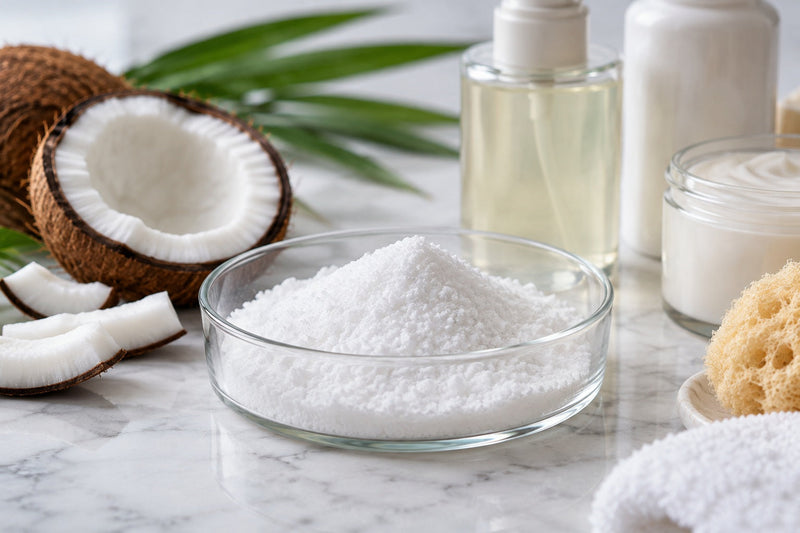
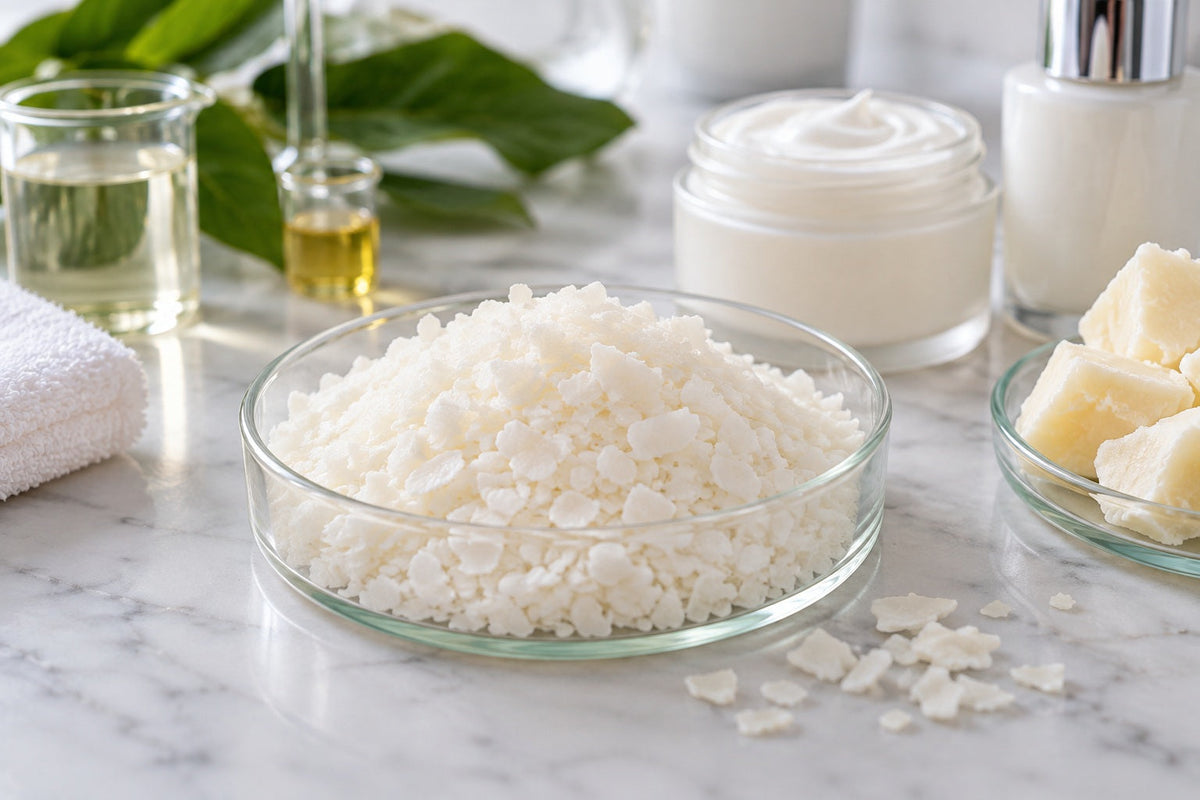
It is supplied as white to off-white waxy flakes with a melting range around 52–57 °C, and supplier guidance is consistent: it must be heated above its melting point — around 60 °C in practice — to dissolve and activate. In plain water it dissolves slightly cloudy; in a surfactant system it goes in clear, because the surfactants are not just its solvent, they are its mechanism. Typical use levels run from about 0.5% to 5%, and the low end already does visible work in a responsive system — which is why dosing by hope overshoots so easily.
PEG-150 distearate as a thickener: the decisions that decide viscosity
It thickens micelles, not water
PEG-150 distearate does not thicken the way a gum thickens water. Its two stearate ends anchor into surfactant micelles while the long PEG chain loops through the water between them, bridging micelles into a loose network and encouraging the elongated, wormlike micelles that give a cleanser its body. Three consequences follow. First, it needs micelles to work — in a surfactant-lean system there is little to bridge, and more thickener will not fix a base that lacks structure. Second, its efficiency depends on which surfactants built the micelles: it performs especially well in ether-sulfate systems such as sodium laureth sulfate blends, and its response elsewhere must be tested, not assumed. Third, because the network is physical, heat, fragrance load, and electrolytes all move the result — the finished, fragranced product is the only viscosity that counts.
Melt it fully, or it never happened
The most common production failure is also the simplest: flakes added to a batch that never got hot enough, or added late to a cooling batch, survive as undissolved specks while the bulk stays thin. The founder concludes the thickener is weak and doubles the dose next time — building a formula around a process error. The disciplined method: melt it fully into the heated water or surfactant phase, around 60 °C, with mixing, until uniform, then let viscosity develop as the system cools. Judge thickness the next day, not in the hot tank — a micellar network reports late.
Dose on a curve, and respect the top of it
Viscosity response rises with dose, but it is not a dial with unlimited travel. Past a system-dependent point, additional PEG-150 distearate buys stringiness and a dragging pour before it buys body, and heavy doses can suppress the foam the customer judges the product by. The professional habit is a ladder: bench the same base at several levels across the typical range, measure each after a full day's rest, and pick the lowest level that hits the pour target in the real bottle. That ladder, recorded, belongs to your surfactants, your fragrance, and your water — no supplier chart can replace it.
And know when it is the wrong tool: sulfate-free and alternative-surfactant systems vary widely in response, and a base built on low micelle-forming surfactants may need a different strategy altogether — a salt curve where the chemistry supports one, or a polymeric thickener designed for that system. The expensive mistake is loyalty: escalating the dose of a mismatched thickener batch after batch instead of testing the mechanism against the base once, honestly.

Where PEG-150 distearate earns its place
- Shampoos — especially ether-sulfate systems, where it builds a rich, controlled pour at low use levels.
- Body washes and shower gels — body and cling without the tight, gelled feel gums can leave.
- Liquid hand washes and bubble baths — stable viscosity that survives the pump and presents well in clear or pearlised packs.
Stability, structure, and packaging are not footnotes
Micellar viscosity is temperature-sensitive by nature: a wash that pours perfectly at room temperature runs thinner warm and heavier cold, so test at both ends of the customer's real world, in the real bottle, with the real pump. Confirm viscosity after fragrance and preservative are in and after heat ageing. Approve the rested, finished product — the hot tank is a liar.
What to decide before you brief a run
Decide the base first — the surfactant system has to deserve thickening. Decide the process second: a genuine melt step at around 60 °C, written into the batch record. Decide the dose third, from a rested bench ladder, at the lowest level that pours right. Decide the check last: viscosity in the finished, fragranced pack, warm and cold.
Keep reading
- Sodium laureth sulfate: the workhorse cleanser behind thick, stable washes
- Cocamidopropyl betaine: the foam partner that shapes viscosity and mildness
How we approach it
At Simplicity Filling Systems, a PEG-150 distearate project starts with the base system, the melt step, and a rested dose ladder on one page, then proves pour, foam, and warm-and-cold viscosity in the real pack before any label is printed. As a full turnkey partner, start to sold, we carry ingredient sourcing, manufacturing, bottling and packaging, fulfillment, and website and marketing support — across perfumes, body washes, creams, sugar scrubs, body oils, massage oils, beach body oil, deodorant, body butter, beard oil, and hair oil. Small runs welcome, startups welcome, built to scale. Comparing quotes? Show us a comparable written quote — we'll match it or beat it.
Frequently asked questions
What does PEG-150 distearate do in a shampoo or body wash? It is a micellar thickener. Its two stearate ends anchor into surfactant micelles while its long PEG chain bridges between them, building the network that gives a cleanser body and a controlled pour — typically at use levels around 0.5–5%.
Why did PEG-150 distearate not thicken my wash? The usual causes are process, not the material: flakes that never fully melted — it needs around 60 °C to dissolve and activate — a surfactant base with too little micellar structure to bridge, or a viscosity reading taken hot, before the network set on cooling. Melt it fully, then judge the rested batch.
How much PEG-150 distearate should I use? Start with a bench ladder inside the typical 0.5–5% range and measure each sample after a full day's rest. More is not a straight line to thicker: past a system-dependent point you get stringiness and suppressed foam. The lowest level that pours right in the real bottle is the dose.
Does PEG-150 distearate work in sulfate-free cleansers? It depends on the surfactant system, because it thickens micelles rather than water. It performs especially well in ether-sulfate systems; in alternative-surfactant bases the response varies and must be benched. If the ladder stays flat, the base needs a different thickening strategy, not a bigger dose.
The bottom line
PEG-150 distearate rewards founders who work its mechanism: a micellar base worth bridging, a real melt step, a dose chosen from a rested ladder, and judgement passed on the finished bottle. Do those four things and a small percentage of an unglamorous flake does the work founders keep trying to buy with more.
Planning a wash that will not hold its body and want the base, thickener, and process checked before the label is printed? Contact us and tell us about the product. We will give you a straight answer on the formula, the packaging, and the run that proves it.
Simplicity Filling Systems — private-label and contract manufacturing in Sunrise, FL. Small runs welcome, startups welcome, built to scale.
Ready for your number?
Run your specs through our Quote Builder for an instant online quote — or reach out for a custom quote.