
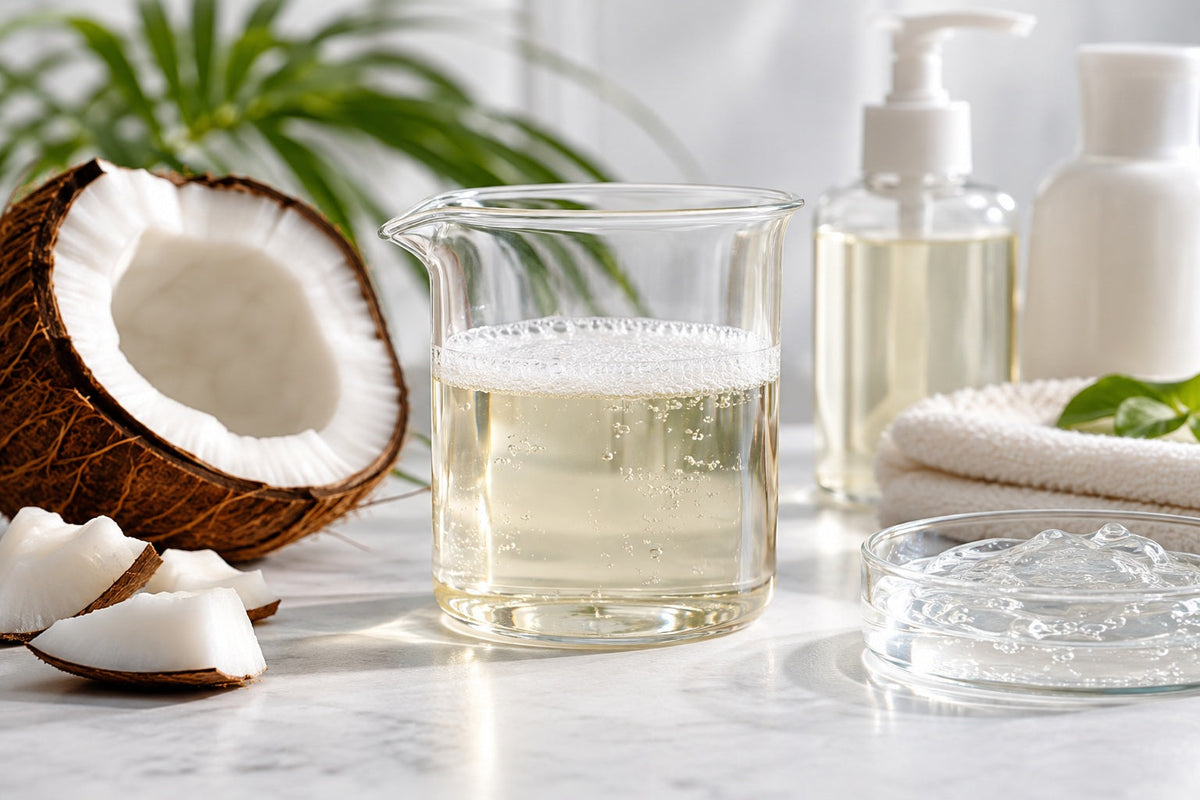
The body wash foams beautifully in the first test and still draws the same two complaints: it feels thin in the hand, and it leaves skin tight. The founder's instinct is to add more of the ingredient with the friendly reputation — cocamidopropyl betaine — as if one co-surfactant could supply mildness and foam in any amount. When the formula barely changes, the ingredient gets called overrated. It was never the lead cleanser. It was hired to partner one, and nobody wrote down the partnership.
Cocamidopropyl betaine in cosmetics is an amphoteric co-surfactant: it boosts and stabilises foam, helps build viscosity, and softens the feel of a stronger primary cleanser. Paired deliberately, it is a large part of why a wash can clean well and still feel kind. Asked to carry cleansing alone, or dosed without regard to the primary it partners, it disappoints both ways.
What cocamidopropyl betaine actually is
On a cosmetic label, it appears as Cocamidopropyl Betaine. It is made from coconut fatty acids: they react with dimethylaminopropylamine to form an amidoamine intermediate, which is then converted to the betaine. The finished molecule is amphoteric — it carries both a positive and a negative charge, and which character dominates shifts with the pH of the formula. In the mildly acidic range most cleansers target, it behaves cationic-like: comfortable alongside anionic primaries, with a softer after-feel.
That partnership is its mechanism. Mixed with a primary anionic surfactant, cocamidopropyl betaine packs into mixed micelles, lowers the charge density of the system, and changes the foam — smaller, denser, creamier bubbles that last instead of collapsing. It also strengthens the salt-thickening response, so viscosity builds with less salt than the primary would need alone.
It is not a primary cleanser, not a preservative, and not a guarantee of mildness. A finished product is mild or harsh as a whole system — total surfactant load, primary choice, pH, and contact time included. It improves the system it joins; it does not redeem one built too strong.
Cocamidopropyl betaine in cleansers: the decisions that decide foam and feel
It is a partner, so brief the pair — not the ingredient
The first decision is what it partners. Alongside a stronger anionic primary, its job is foam quality, viscosity support, and a gentler feel. In a sulfate-free system built on glucosides, isethionates, or amino-acid surfactants, its job shifts toward foam rescue, making the modest lather of mild primaries feel complete. The right level is relative to the primary: the ratio decides foam character, clarity, viscosity response, and after-feel together. A copied percentage from a different surfactant system transfers none of that.
Viscosity is a system response, not a betaine setting
Founders ask how much betaine makes a wash thick. Thickness in these systems comes from how the mixed micelles respond to salt and pH — the salt curve — and that curve has a peak. Add salt toward the peak and the product builds a satisfying, honeyed pour. Pass the peak and it thins again, sometimes dramatically — the batch did not fail, the curve was overshot. Set viscosity by mapping the system, lock the salt and pH that hold it, and re-check after fragrance and heat.
Purity and pH are part of the mildness story
The honest footnote: the sensitisation historically linked to this ingredient has been traced largely to residual manufacturing impurities — unreacted amidoamine and dimethylaminopropylamine — rather than to cocamidopropyl betaine itself. That makes supplier grade a real formulation decision, not a purchasing detail. Source a cosmetic grade with controlled impurity limits, and hold the finished product in its intended mildly acidic pH range. Mildness is specified and verified, not asserted because a familiar name is on the label.

Where cocamidopropyl betaine earns its place
- Body washes and shower gels — as the co-surfactant that turns a primary cleanser's foam creamy and stable and helps the gel hold its pour.
- Foaming face washes — where foam quality is judged in the first seconds and the after-feel decides whether the customer stays.
- Shampoos and liquid hand soaps — for lather, viscosity, and a softer feel in daily-use rinse-off systems.
Stability, structure, and packaging are not footnotes
A cleanser has to pour the same in month six as on filling day. Test viscosity, clarity, foam, and scent in the real bottle after heat exposure, and check the pump or cap delivers the intended dose at the finished viscosity — a foam pump and a gel are different designs, not interchangeable packs. Fragrance can thin or cloud a betaine system, so only the scented, finished product is worth approving.
What to decide before you brief a run
Decide the primary surfactant first. Decide the partnership second — the betaine ratio, the salt curve, and the pH that hold foam and viscosity together. Decide the specification third: cosmetic grade, impurity limits, and the finished-product tests. Write claims last, from the system as tested, never from the reputation of one ingredient.
Keep reading
- Body Wash: the everyday product customers judge without mercy
- Foaming Face Wash: the product your customer judges in the first three seconds
How we approach it
At Simplicity Filling Systems, a cocamidopropyl betaine project starts with the surfactant system on one page — primary, partner, ratio, salt curve, and pH — then checks foam, viscosity, and after-feel in the real pack before any label is printed. As a full turnkey partner, start to sold, we carry ingredient sourcing, manufacturing, bottling and packaging, fulfillment, and website and marketing support — across perfumes, body washes, creams, sugar scrubs, body oils, massage oils, beach body oil, deodorant, body butter, beard oil, and hair oil. Small runs welcome, startups welcome, built to scale. Comparing quotes? Show us a comparable written quote — we'll match it or beat it.
Frequently asked questions
What does cocamidopropyl betaine do in a body wash? As an amphoteric co-surfactant, it boosts and stabilises foam, helps build viscosity via the salt response, and softens the primary cleanser's feel, so the wash cleans well without feeling as harsh.
Is cocamidopropyl betaine a sulfate? No. It is not a sulfate and not a primary anionic cleanser. It is usually paired with a primary surfactant — a sulfate such as sodium laureth sulfate, or a sulfate-free alternative — so check the whole system, not one name, when a sulfate-free claim matters.
Why is my body wash thin even though it contains cocamidopropyl betaine? Viscosity comes from the whole system: the ratio to the primary surfactant, the salt level relative to the peak of the salt curve, pH, and fragrance. Too little salt under-builds it; too much overshoots the peak and thins it again.
Is cocamidopropyl betaine safe for sensitive skin? It is widely used specifically to improve the mildness of rinse-off systems. The sensitisation reports in the literature have been linked mainly to residual manufacturing impurities, which is why cosmetic grade with controlled impurity limits and a properly designed total system matter more than the ingredient name alone.
Can cocamidopropyl betaine be the only surfactant in a cleanser? It can cleanse, but it is rarely the strongest design. Its value is as a partner: foam quality, stability, viscosity support, and feel. Built on it alone, a formula usually under-delivers on cleansing or foam next to a deliberate pairing.
The bottom line
Cocamidopropyl betaine rewards founders who brief the partnership, not the ingredient: a primary chosen on purpose, a ratio set against it, a salt curve mapped instead of guessed, and a grade specified properly. That is how a wash foams like a premium product and still feels kind on the hundredth use.
Planning a body wash, face wash, or shampoo and want the surfactant system, viscosity, and claims checked before the label is printed? Contact us and tell us about the product. We will give you a straight answer on the formula, the packaging, and the run that proves it.
Simplicity Filling Systems — private-label and contract manufacturing in Sunrise, FL. Small runs welcome, startups welcome, built to scale.
Ready for your number?
Run your specs through our Quote Builder for an instant online quote — or reach out for a custom quote.
More from News

PEG-150 Distearate: The Thickener Founders Add Cold, Dose by Hope — and Then Blame When the Wash Stays Thin
Sodium Cocoyl Isethionate: The Gentle Cleanser Founders Expect to Pour Like Water — and Then Blame When the Bar Turns Gritty
