
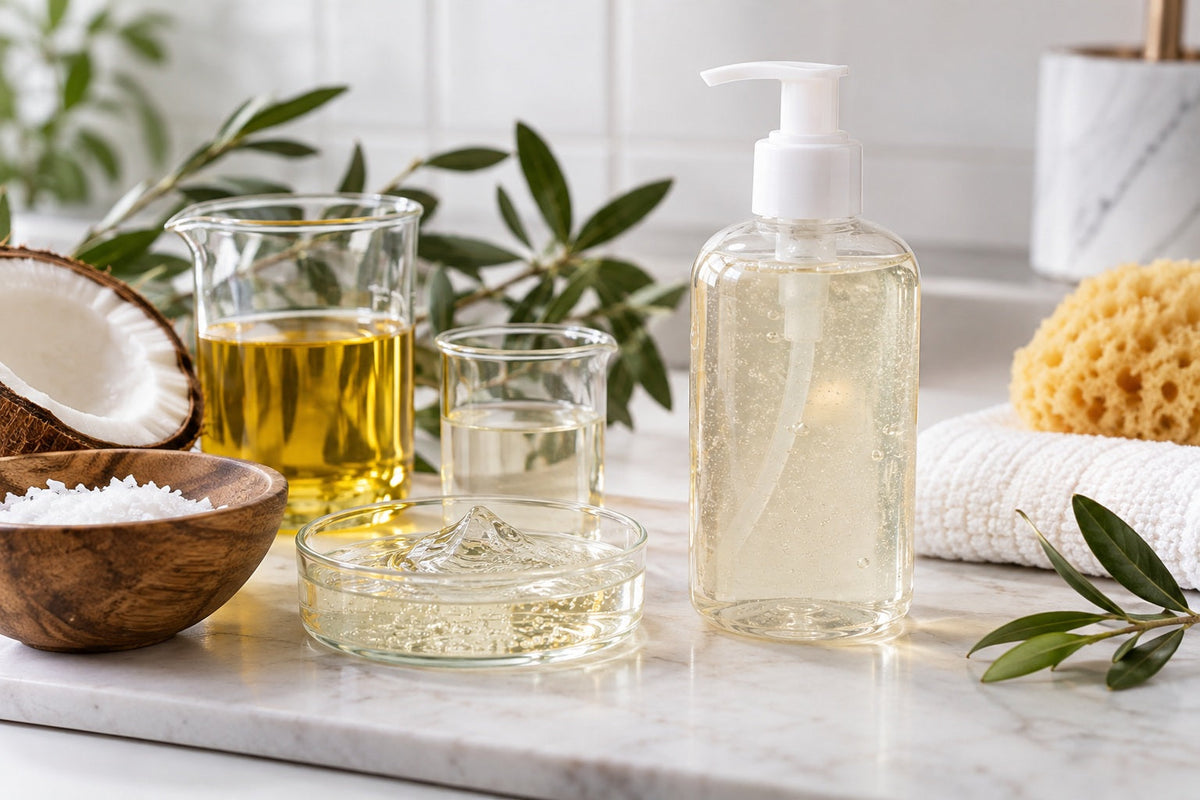
Nobody gives a body wash a grace period. It is used daily, half-awake, in a wet room, and compared silently against every wash that came before it. If the lather feels thin, the scent vanishes before the towel, or the bottle fights back with wet hands, the customer does not write a thoughtful review. She just does not reorder. That unforgiving rhythm is also the opportunity: a wash that earns its place in the shower becomes the most reliable reorder in a line.
What a body wash has to do
A body wash is a water-based cleanser built for full-body daily use. Its job sounds simple and is not:
- Clean without leaving skin feeling stripped or tight — the after-feel is remembered longer than the lather.
- Lather that feels generous at a realistic dose — customers judge richness in seconds, at the amount they actually squeeze out.
- A scent that performs in steam, then behaves — present in the shower, pleasant on skin afterwards, not fighting a lotion or fragrance layered over it.
- Thickness that pours and pumps properly — too thin reads cheap and wastes product; too thick clogs, glugs, and frustrates.
Every one of those is a formulation and packaging decision made long before the first customer steps into a shower.
Lather is theatre — and also information
Founders sometimes apologise for caring about lather, as if it were a trick. It is not. Lather is how a customer perceives coverage, richness, and whether the dose she used was enough. A wash can clean well and still feel unsatisfying if the foam is sparse — and a dissatisfied daily user is a lost reorder.
Build lather for real conditions: hard and soft water behave differently, a washcloth, loofah, and bare hands build foam differently, and the dose in a real shower is smaller than in a careful sample test. Sample the way customers actually wash. If your wash is lower-lather by design, say so proudly and explain the feel you built instead — surprises disappoint, positioning does not.
Thickness: the quiet quality signal
Body wash thickness is read as quality before a single ingredient is noticed. Watery product running through fingers signals diluted and forgettable. A controlled, cushioned pour signals care.
Thickness is also fragile. Fragrance, temperature, and time can all shift how a wash pours months after it was made, which is why thickness should be checked in the finished product, stored, over time — and why a pump or disc-top that suited the fresh batch must still suit the batch at month six. A bottle a customer has to shake, squeeze with two hands, or store upside down is a daily reminder working against your next sale.
Scent in a rinse-off product
A body wash scent has the strangest job in body care: perform at full strength for a few minutes, mostly in steam, then step back. Steam lifts fragrance, so a wash that smells balanced at the sink can bloom much stronger in a hot shower — judge it there, not at a desk.
Decide the after-story on purpose. Some washes are the scent event of the routine, with a matching body oil or butter carrying a softer version afterwards. Others clean the stage and leave scent to a lotion or perfume. Coordinated collections work when each product's intensity respects its role: the rinse-off product can be brighter, the leave-on products should be the ones dosed for hours of wear. Also check the finished wash for colour shift over time, since fragrance can change the look of a water-based product in a clear bottle.
Skin feel and honest claims
The tight, squeaky feeling after a wash is often marketed as clean. Many customers have learned to read it as dry instead. The honest ground for a body wash is cosmetic: how skin feels and looks after rinsing, how the product spreads and rinses, and what after-feel is left behind — by design, described accurately.
Keep claims on that ground. Daily products sell on experience and habit, not treatment language. A clear ingredient list, a pH considered for a skin cleanser, an appropriate preservative system, and stability and preservative efficacy testing do more for a brand than any bold promise on the front label.
Packaging for a wet room
Body wash packaging works in the harshest environment in the house: wet, soapy, one-handed, and often dropped. Choose a bottle with a grip that survives wet hands, a closure that doses with one hand, and a label that stays legible after weeks of steam. Consider where the last quarter of the product goes — a bottle that traps it trains customers to feel short-changed at the moment they decide whether to reorder. Test the full unit in a real shower over weeks, not at a dry bench for an afternoon.
Where body wash fits in a line
Body wash is the natural front door of a body care line: the lowest-commitment daily purchase, the product a new customer tries first, and the base of a routine that a body oil, body butter, or scrub in the same scent family completes. For online sellers, it is also a natural subscription and bundle anchor. Launch one scent and one feel, sized to prove reorder, and let the routine grow around a wash customers already trust every morning.

How we approach it
At Simplicity Filling Systems, body washes are part of the range we manufacture and fill — alongside perfumes, creams, sugar scrubs, body oils, massage oils, beach body oil, deodorant, body butters, and supplements. Our approach is after-feel first, lather and thickness judged under real shower conditions, scent judged in steam, and packaging tested wet, one-handed, over time. As a full turnkey partner, start to sold, we can carry the work through ingredient sourcing, manufacturing, bottling and packaging, fulfillment, and website and marketing support. Small runs welcome, startups welcome, built to scale. Comparing quotes? Use our price-match promise: show us a comparable written quote — we'll match it or beat it.
Frequently asked questions
How much lather should a body wash have? Enough that a realistic dose feels generous and covers easily, in the way your customers actually wash — hands, cloth, or loofah differ. If a formula is lower-lather by design, position that honestly.
Why did my body wash get thinner over time? Thickness in a water-based wash can shift with fragrance, temperature, and storage. Check viscosity in the finished, stored product over time, and test packaging against the product as it ages, not only fresh.
Should body wash scent match my body oil or butter? It can, and coordinated families sell routines well. Keep the roles distinct: the wash performs briefly in steam and rinses off, so leave-on products should carry the longer, softer version of the scent.
Does a body wash need preservatives and testing? Yes. A water-based product needs an appropriate preservative system, plus preservative efficacy and stability testing to stay sound through its shelf life.
Can body wash be my first product? Yes. It is a daily-use product customers try readily and reorder predictably. Launch one scent and feel, prove the reorder, then build the routine around it.
The bottom line
A body wash wins or loses in ordinary moments: a half-awake shower, wet hands, a dose squeezed without thinking. Build the lather, thickness, scent, and after-feel for those moments, test them where they actually happen, and the most ordinary product in the bathroom becomes the steadiest reorder in your line.
Thinking about a body wash for your line? Contact us and tell us the feel and scent family you are aiming for. We will give you a straight answer on the formula, the bottle, and the run that proves it.
Simplicity Filling Systems — private-label and contract manufacturing in Sunrise, FL. GMP facility, 18+ years. Small runs welcome, startups welcome, built to scale.*
Ready for your number?
Run your specs through our Quote Builder for an instant online quote — or reach out for a custom quote.
More from News

PEG-150 Distearate: The Thickener Founders Add Cold, Dose by Hope — and Then Blame When the Wash Stays Thin
Sodium Cocoyl Isethionate: The Gentle Cleanser Founders Expect to Pour Like Water — and Then Blame When the Bar Turns Gritty
