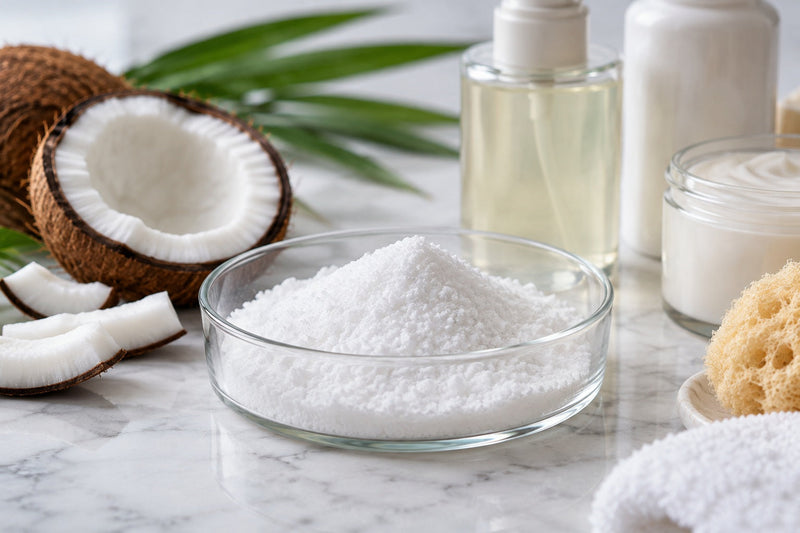
A founder deletes sodium laureth sulfate from a brief before the first sample is made — not because the formula failed, but because a comment thread said the word sulfate. Then the replacement wash will not foam in hard water, will not thicken, and costs more to make worse. Sodium laureth sulfate is not a villain or a hero — it is the most proven rinse-off cleanser in personal care, and it rewards founders who handle it like the specific material it is.
Sodium laureth sulfate in cosmetics is an anionic surfactant: the ethoxylated partner of sodium lauryl sulfate, built for rich foam, dependable cleansing, and a viscosity response a formulator can actually steer. Almost every failure blamed on it traces to three handling mistakes — a dilution that gelled, a pH parked where the sulfate ester slowly hydrolyses, or salt added past the peak of its own curve. All three are process decisions, not ingredient flaws.
What sodium laureth sulfate actually is
On a cosmetic label, it appears as Sodium Laureth Sulfate. It is made by ethoxylating a fatty alcohol — typically a coconut or palm-kernel C12–C14 cut — then sulfating that ethoxylate and neutralising it. The ethoxy groups are the whole point: they sit between the fatty chain and the sulfate head, making the molecule milder than sodium lauryl sulfate, more hard-water tolerant, and easier to thicken with salt.
It ships in two strengths founders routinely confuse: a viscous paste at roughly 70% active matter, and a pourable liquid at roughly 27–28% active. A formula written against one and made with the other is wrong by more than double before anything else goes in the tank. Every serious brief states the grade and the active matter, not just a percentage and a name.
Two internet claims deserve straight answers. First, 1,4-dioxane: it is not an ingredient and never added — it is a trace byproduct of ethoxylation that reputable cosmetic-grade supply is processed and tested to keep at low parts-per-million levels. Buy specified, tested material; do not fear the INCI name. Second, safety: the Cosmetic Ingredient Review has assessed sodium laureth sulfate as safe in rinse-off products when formulated to be non-irritating — exactly why the blend around it matters more than the headline.
Sodium laureth sulfate in body wash and shampoo: the decisions that decide the product
Dilution is a process, not a pour
The 70% paste does not dissolve like a liquid surfactant. Diluted carelessly, it passes through a mid-concentration band where it forms a stiff gel that can stall a batch for hours. The professional method is unglamorous: add the concentrate to water, keep the batch moving, and use warmth properly. Supplier technical guidance for the leading 70% grade is explicit that where cold incorporation fails, the material can be dissolved with hot water — around 80 °C is recommended for that step — and the neat paste itself may be warmed to about 50 °C short-term, with heating water capped around 60 °C. What damages the paste is localised overheating and prolonged holding, not warmth itself. A process built around a made-up low temperature ceiling makes batches harder, not safer.
pH is where shelf life is quietly decided
The sulfate head is an ester, and esters hydrolyse — conditionally. For sodium laureth sulfate, hydrolysis is acid-catalysed: it accelerates below about pH 5, and worsens with prolonged holding and heat. Inside its normal working window — finished cleansers are typically held around pH 5.5–6.5, also the skin-friendly range — the ingredient is stable for the life of the product. The failure pattern is a founder chasing an acidic marketing story, parking a wash at pH 4, and spending a year of shelf life on a chemistry reaction. Adjust pH last, with a dilute citric acid solution, and re-check it after fragrance goes in.
Salt thickens it — on a curve, not a dial
This is the system where salt genuinely works. Sodium chloride screens the charge on the micelles, the micelles grow, and viscosity climbs — typically somewhere in the 1–2% salt region for a standard wash, with cocamidopropyl betaine in the blend raising and smoothing the response. But the response is a curve with a peak. Past the peak, more salt thins the product back out. Add salt gradually, in solution, measuring as you go — and write the peak down, because that number, for that exact blend, is part of the formula.
No competent wash is sodium laureth sulfate alone, either: amphoteric partners such as cocamidopropyl betaine soften the feel, enrich the foam, and let the total cleansing load come down while lather stays generous. Judge the finished system after a week of real use — never the lead surfactant's reputation in either direction.

Where sodium laureth sulfate earns its place
- Body washes and shower gels — dependable cleansing and foam against real soil: sunscreen, sweat, and sebum, with salt-steerable viscosity.
- Shampoos — the default primary cleanser for daily and clarifying formats, blended for foam quality and after-feel.
- Hand washes and bubble baths — where generous, stable foam and hard-water reliability are the product.
Stability, structure, and packaging are not footnotes
Test the finished, fragranced product in the real bottle: viscosity at the salt peak can drift if fragrance or preservative load shifts the system, and pH should be confirmed after heat ageing, because drift toward acid is drift toward hydrolysis.
What to decide before you brief a run
Decide the grade first — 70% paste or 28% liquid — with active matter in the brief. Decide the system second: lead level, mildness partners, total load. Decide the pH window third, in writing, inside the stable range. Find the salt peak fourth, by measurement, and record it.
Keep reading
- Cocamidopropyl betaine: the foam partner behind mild, stable lather
- Body wash: the everyday product customers judge without mercy
How we approach it
At Simplicity Filling Systems, a sodium laureth sulfate project starts with the grade, the active matter, and the pH window on one page, then proves foam, viscosity at the measured salt peak, and a week of real use in the real pack before any label is printed. As a full turnkey partner, start to sold, we carry ingredient sourcing, manufacturing, bottling and packaging, fulfillment, and website and marketing support — across perfumes, body washes, creams, sugar scrubs, body oils, massage oils, beach body oil, deodorant, body butter, beard oil, and hair oil. Small runs welcome, startups welcome, built to scale. Comparing quotes? Show us a comparable written quote — we'll match it or beat it.
Frequently asked questions
Is sodium laureth sulfate safe in cosmetics? The Cosmetic Ingredient Review has assessed it as safe in rinse-off products when formulated to be non-irritating. The trace 1,4-dioxane question is a sourcing specification: cosmetic-grade material is processed and tested to low parts-per-million limits — check the certificate of analysis.
Why did my SLES wash turn thin after I added more salt? Because salt thickening follows a curve. Viscosity rises to a peak — often around 1–2% salt in a standard system — then falls as more is added. Find and record the peak for your exact blend instead of adding more.
What pH should a sodium laureth sulfate cleanser be? Typically around 5.5–6.5: skin-friendly and inside the stable window. Hydrolysis is acid-catalysed and accelerates below about pH 5, especially with prolonged holding and heat — acidic positioning stories cost shelf life.
Can sodium laureth sulfate be dissolved with hot water? Yes — supplier guidance for the 70% grade recommends hot water, around 80 °C, where cold incorporation fails, and allows warming the neat paste to about 50 °C short-term with heating water capped near 60 °C. The real enemies are localised overheating and prolonged holding, not warmth itself.
The bottom line
Sodium laureth sulfate rewards founders who specify it properly: the right grade, a mildness blend around it, pH inside its window, and salt stopped at its measured peak. Handled that way, it is still the most dependable foundation a body wash or shampoo can be built on.
Planning a body wash or shampoo and want the grade, blend, and viscosity checked before the label is printed? Contact us and tell us about the product. We will give you a straight answer on the formula, the packaging, and the run that proves it.
Simplicity Filling Systems — private-label and contract manufacturing in Sunrise, FL. Small runs welcome, startups welcome, built to scale.
Ready for your number?
Run your specs through our Quote Builder for an instant online quote — or reach out for a custom quote.