
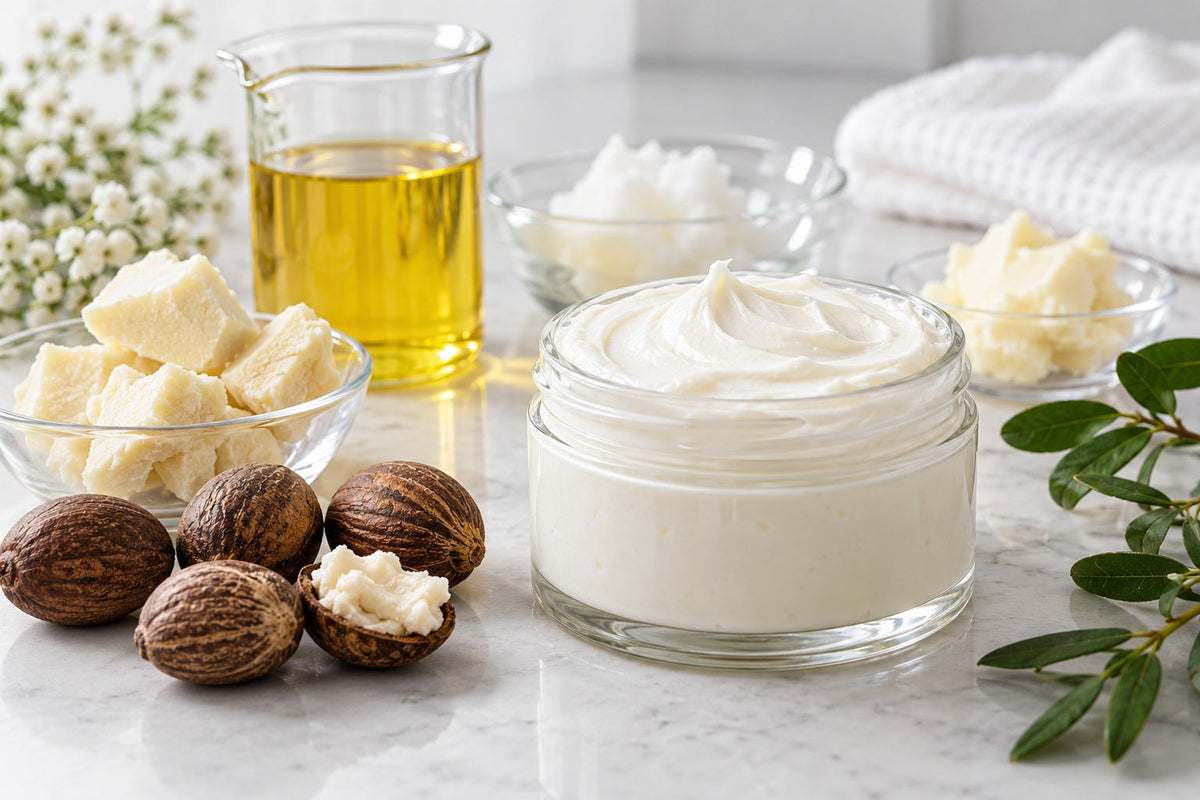
A customer twists open a jar, runs a finger across the surface, and decides — before reading a word on your label — whether your brand understands rich, serious body care or just put a thick cream in a jar and hoped.
Body butter lives or dies in that first scoop. It is one of the simplest products in body care and one of the least forgiving, because there is almost nothing to hide behind. No pump, no foam, no rinse-off moment. Just texture, scent, spread, and the skin feel left behind.
What a body butter actually has to do
A body butter is a rich, concentrated body moisturizer built around butters and oils, rather than the lighter, water-forward structure of a lotion. Customers reach for it when a lotion feels too thin — after a shower, on dry hands and elbows, on legs in winter, or as the last step in an evening routine.
The expectations that come with that job are specific:
- Rich without being waxy — substantial in the jar, then melting and spreading on skin, not dragging like candle wax.
- Honest in language — it is a cosmetic. It can speak to softness, smoothness, comfort, and appearance. It cannot promise to treat skin conditions.
- Consistent from first scoop to last — the bottom of the jar should feel like the top, weeks later, in a real bathroom.
- Stable every time — scent, color, and texture that do not separate, grain, or change character on the shelf.

Texture: whipped, dense, and the choice between them
Texture is the brand decision in a body butter. Two broad families cover most of the market, and neither is automatically better.
Whipped body butter
Whipping incorporates air, giving a lighter scoop and a softer first impression customers often call luxurious. The trade-offs are real: it fills a jar by volume, so it looks full with less product by weight, and it can be more sensitive to heat in transit — a whipped butter that warms and slumps may not return to its original look, even when still perfectly usable.
Dense, poured body butter
A dense butter is poured and set firm. It feels substantial, travels well, and gives a clean, premium surface. The risk is the opposite one: too firm in a cool room, and the customer is scraping rather than scooping. Judge firmness at realistic temperatures, not just on production day. Whichever you choose, write your copy to match the experience you ship — a whipped butter sold with dense-butter expectations manufactures its own bad reviews.
The greasiness question — answered honestly
Rich and greasy are neighbours, and every founder has to decide where on that line the product sits. Some customers want a deep, lingering richness and apply at night, expecting exactly that. Others want rich in the jar and settled quickly on skin.
You manage that balance in formulation — the choice and proportion of butters and oils, and the supporting ingredients that change spread and settle. You do not manage it with adjectives. Calling a slow-settling butter fast-absorbing just makes the first use a disappointment.
For a first launch: define the use moment — night ritual, post-shower daily use, or targeted dry-area care — build and sample toward it on real skin, and let the copy describe the true finish. That honesty is a sales tool. Customers who match your finish become repeat buyers; the ones who would have hated it were never going to reorder anyway.
Scent in a butter base
A butter holds scent differently from a lotion or a wash. There is no rinse, and the product stays on skin, so fragrance has time and warmth to develop. A scent pleasant in the jar can grow heavy over hours, and a scent dosed for a lotion can overwhelm in a butter. Sample scent in the finished base, worn for a full day, before you lock it.
Jars, seals, and the life of the product
Body butter lives in a jar, which means fingers in product, air exposure at every use, and a wide surface to protect:
- A jar the customer can use — wide enough for a clean scoop, stable on a counter, with a lid that reseats easily with moisturized hands.
- A proper seal — tamper evidence that reassures a first-time buyer, and protection in storage and transit.
- Fill and net weight that agree — especially with whipped formulas, where volume and weight tell different stories.
- Stability in the finished jar — test for graining, separation, and scent shift in the package you will ship, over time. Heat in a truck and cold in a warehouse are part of its real life.
Where body butter fits in a line
Body butter is a strong anchor. It pairs naturally with sugar scrubs — exfoliate first, moisturize after — with body washes in a shared scent, and with body oils for customers who layer. In gift sets, a jar gives weight and perceived value smaller items do not.
How we approach it
At Simplicity Filling Systems, body butter is a capability we manufacture as part of a body care range that also includes body washes, creams, sugar scrubs, body oils, massage oils, and beach body oil — within a wider line covering perfumes, deodorant, and supplements. We start with the texture decision — whipped or dense — build toward the finish your use moment demands, validate scent in the finished base, and prove the result in the jar you will ship. As a full turnkey partner, start to sold, we can also carry a product through ingredient sourcing, manufacturing, bottling and packaging, fulfillment, and the website and marketing support behind it. Small runs welcome, startups welcome, built to scale. If you are comparing quotes, use our price-match promise: show us a comparable written quote — we'll match it or beat it.
Frequently asked questions
What is the difference between body butter and body lotion? A body butter is richer and more concentrated, built around butters and oils and made to linger on skin. A lotion is lighter and water-forward, spreads faster, and settles sooner. Many brands sell both for different use moments.
Is whipped or dense body butter better? Neither is automatically better. Whipped butter feels lighter on the scoop and can be more heat-sensitive in transit. Dense butter feels substantial and travels well but must not set too firm to scoop. Choose for your use moment and test at realistic temperatures.
Why does my body butter feel greasy? Greasiness is a formulation balance — the butters, oils, and supporting ingredients and their proportions decide spread and settle. The fix is in the formula, matched to an honest description of the finish.
Does body butter need a preservative? Many classic butters are built without water, which changes the preservative picture compared with a water-based lotion. The right system depends on your formula and how customers use it, including wet hands in a jar, so it belongs in formulation and appropriate testing.
Can body butter be a first product for a new brand? Yes. It is focused, easy to demonstrate, and reorder-friendly. Launch one texture and scent, prove the reorder, and extend from a base customers trust.
The bottom line
Body butter rewards founders who decide texture, finish, and jar on purpose — then describe all three honestly. Get those right and the first scoop sells the second jar.
Thinking about a body butter for your line? Contact us and tell us the texture and finish you are aiming for. We will give you a straight answer on the formula route, the jar, and the run that proves it.
Simplicity Filling Systems — private-label and contract manufacturing in Sunrise, FL. GMP facility, 18+ years. Small runs welcome, startups welcome, built to scale.*
Ready for your number?
Run your specs through our Quote Builder for an instant online quote — or reach out for a custom quote.
More from News

PEG-150 Distearate: The Thickener Founders Add Cold, Dose by Hope — and Then Blame When the Wash Stays Thin
Sodium Cocoyl Isethionate: The Gentle Cleanser Founders Expect to Pour Like Water — and Then Blame When the Bar Turns Gritty
