
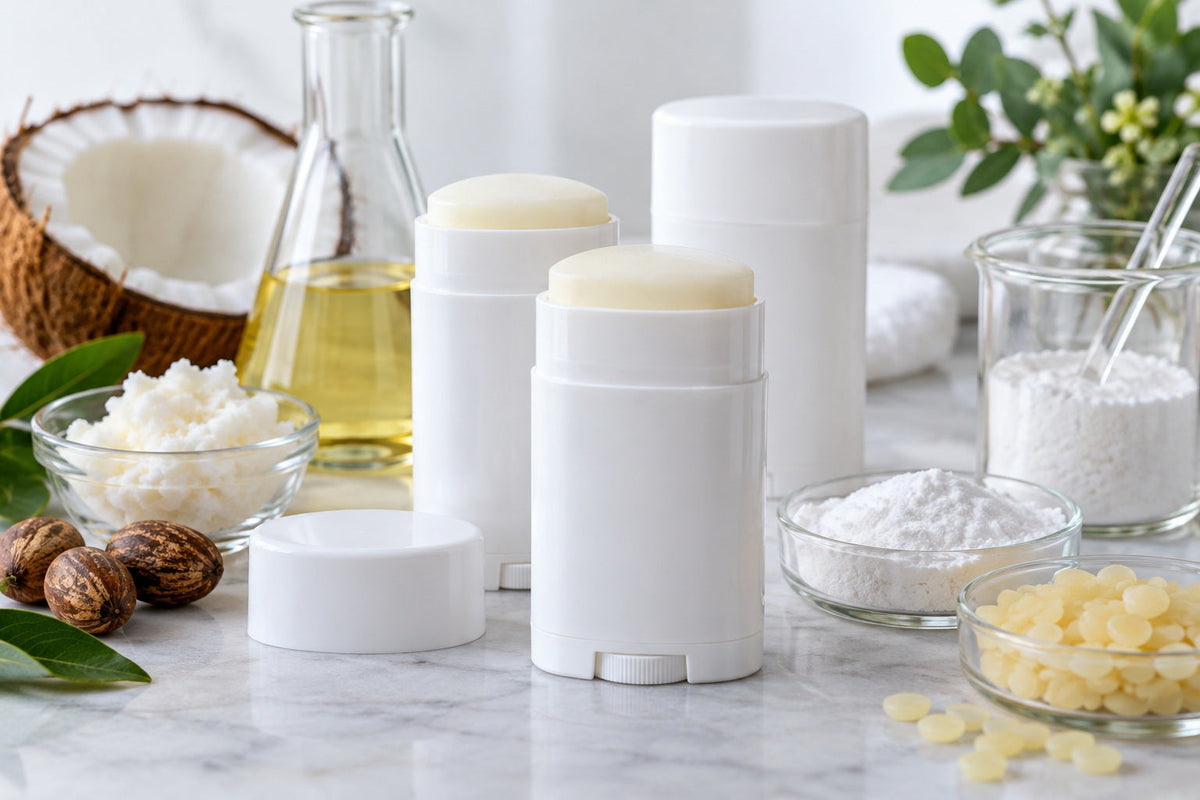
A deodorant stick has the hardest brief in body care: be applied in seconds, half-dressed, and then be forgotten completely. If it drags, crumbles, stains a shirt, or fades by midday, the customer does not troubleshoot it. She switches brands and never thinks about yours again. Get it right, though, and a stick becomes one of the most loyal reorders in a line — bought on habit, trusted without thought.
What a deodorant stick actually is
A deodorant stick is a solid cosmetic product in a twist-up container, designed to be swiped onto underarm skin. As a cosmetic, its honest job is simple to state and hard to deliver: apply smoothly, feel comfortable, carry a scent the customer enjoys, and help the underarm area feel fresh through a normal day.
That cosmetic framing matters. In the United States, deodorants and antiperspirants are not the same category. Antiperspirants that claim to reduce sweating are regulated as over-the-counter drugs. A cosmetic deodorant does not make that claim. Founders who blur that line create a compliance problem out of a clean, sellable product. Build it as a cosmetic, describe it as a cosmetic, and let comfort, glide, and scent do the selling.

Glide is the first review
The first swipe is the review. A stick that drags pulls at skin and feels unfinished. A stick that is too soft smears, over-applies, and leaves the customer feeling coated. The sweet spot is a firm stick that softens on contact and lays down an even, thin layer in two or three passes.
Glide is a structure decision. The balance of waxes, butters, and oils decides whether a stick holds its shape in a warm bathroom, releases product evenly, and recovers its surface between uses. Test glide the way customers use it: on warm skin, in a hurry, with the amount a real person actually applies — not a careful, heavy lab application.
Residue, marks, and the shirt test
Ask customers why they abandoned a deodorant and clothing comes up fast. White marks on dark fabric, greasy-feeling residue, and product that transfers onto a shirt undo good scent work in one dressing moment.
This is why the shirt test belongs in development: apply, wait the short time a real routine allows, dress, and check the garment later. The goal is a dry-feeling, even application — and a shirt she does not have to think about.
Structure: firm in the tube, comfortable on skin
A stick lives a double life. It must stay solid in a warm car, a gym bag, and a steamy bathroom, then behave softly the moment it touches skin. Too hard and it drags and can crack or crumble at the edge. Too soft and it slumps, mushrooms over the rim, and doses unevenly.
Heat is the honest test. Sticks that look perfect at room temperature can sweat, soften, or shrink away from the container wall when stored warm. Check finished sticks stored over time, including warm conditions that mirror shipping and real bathrooms. Surface appearance matters too — a smooth, clean top reads as quality before the first swipe.
Scent in a leave-on daily product
Underarm scent is personal and close. It sits near the nose all day, warms with the body, and mixes with clothing. A fragrance that is pleasant in the tube can bloom much stronger after an hour of wear, so judge scent on skin, over hours, not from the open stick.
Decide the role on purpose. Some sticks are the scent event, coordinated with a matching body wash or body oil. Others stay quiet and let a perfume lead. One proven base in a small, deliberate scent range is a stronger launch than a wall of variants nobody reorders twice.
The twist-up container is part of the formula
With sticks, packaging is the applicator. The dial must advance smoothly without slipping back, the platform must hold the stick without wobble, and the cap must protect a surface the customer puts on skin. An oval profile suits underarm application for most brands.
Fill quality shows here too. Air pockets, sink marks, and sticks that loosen in the tube are production defects a customer reads as carelessness. Test the finished, filled unit — advance it, retract it, cap it, carry it — because that unit, not the bulk batch, is what gets reviewed.
Where a deodorant stick fits in a line
A stick anchors a daily routine like few products can. It pairs naturally with a body wash in the same scent family for the shower-to-dressing sequence, and it gives online sellers a compact, sturdy, repeat-purchase product. For a first launch, prove one stick — one base, one lead scent — and earn the reorder before expanding the range.
How we approach it
At Simplicity Filling Systems, deodorant is part of the range we manufacture and fill — alongside perfumes, body washes, creams, sugar scrubs, body oils, massage oils, beach body oil, body butters, and supplements. Our approach is glide first, residue checked with a real shirt test, scent judged over hours of wear, and structure tested warm as well as at room temperature. As a full turnkey partner, start to sold, we can carry the work through ingredient sourcing, manufacturing, bottling and packaging, fulfillment, and website and marketing support. Small runs welcome, startups welcome, built to scale. Comparing quotes? Use our price-match promise: show us a comparable written quote — we'll match it or beat it.
Frequently asked questions
What is the difference between a deodorant and an antiperspirant? A cosmetic deodorant is made to apply comfortably, carry scent, and help the underarm feel fresh. Antiperspirants that claim to reduce sweating are regulated as over-the-counter drugs in the United States, which is a different category with different requirements. Keep a cosmetic stick's claims on the cosmetic side.
Why does my deodorant stick drag or crumble? That is usually a structure balance problem. A stick that is too firm drags and can crack at the edge; one that is too soft smears and over-applies. Glide should be tested on warm skin at a realistic dose.
How do I reduce white marks and transfer? Build for a thin, even, dry-feeling application and run a shirt test during development: apply, dress after a normal wait, and check the garment later. Residue is a formula and dose issue, not something a label note can fix.
Should I launch scented or unscented first? Launch the version your customer actually asked for, and prove the reorder on one stick. Many lines add a lighter or unscented option once the base is proven, rather than splitting a first run across variants.
Can a deodorant stick be my first product? Yes. It is a daily-use product with a strong reorder habit and a compact format that ships well. Prove one base and one lead scent first.
The bottom line
A deodorant stick wins by disappearing: smooth on, comfortable all day, nothing on the shirt, no second thought at reorder time. Build the glide, structure, and scent for real mornings and warm bathrooms, test the finished stick in its real container, and this quiet daily product becomes a dependable anchor for your line.
Thinking about a deodorant stick for your line? Contact us and tell us the scent direction and feel you are aiming for. We will give you a straight answer on the base, the container, and the run that proves it.
Simplicity Filling Systems — private-label and contract manufacturing in Sunrise, FL. GMP facility, 18+ years. Small runs welcome, startups welcome, built to scale.*
Ready for your number?
Run your specs through our Quote Builder for an instant online quote — or reach out for a custom quote.
More from News

PEG-150 Distearate: The Thickener Founders Add Cold, Dose by Hope — and Then Blame When the Wash Stays Thin
Sodium Cocoyl Isethionate: The Gentle Cleanser Founders Expect to Pour Like Water — and Then Blame When the Bar Turns Gritty
