
The review almost never says "this oil oxidized." It says the smell was off. It says the product seemed old. It says they loved the first bottle and the second one was different. Very often, what changed was not the recipe — it was time, air, and an unprotected oil phase slowly turning rancid on the shelf. Rosemary oleoresin extract is one of the most practical tools a founder has against that failure, precisely because customers will never know it is there when it works.
It is not glamorous, it is not the name on the front of the bottle, and it is not a preservative. It is an oil-phase antioxidant with a specific, valuable job — and confusing that job with someone else's is where founders get hurt.
What rosemary oleoresin extract actually is
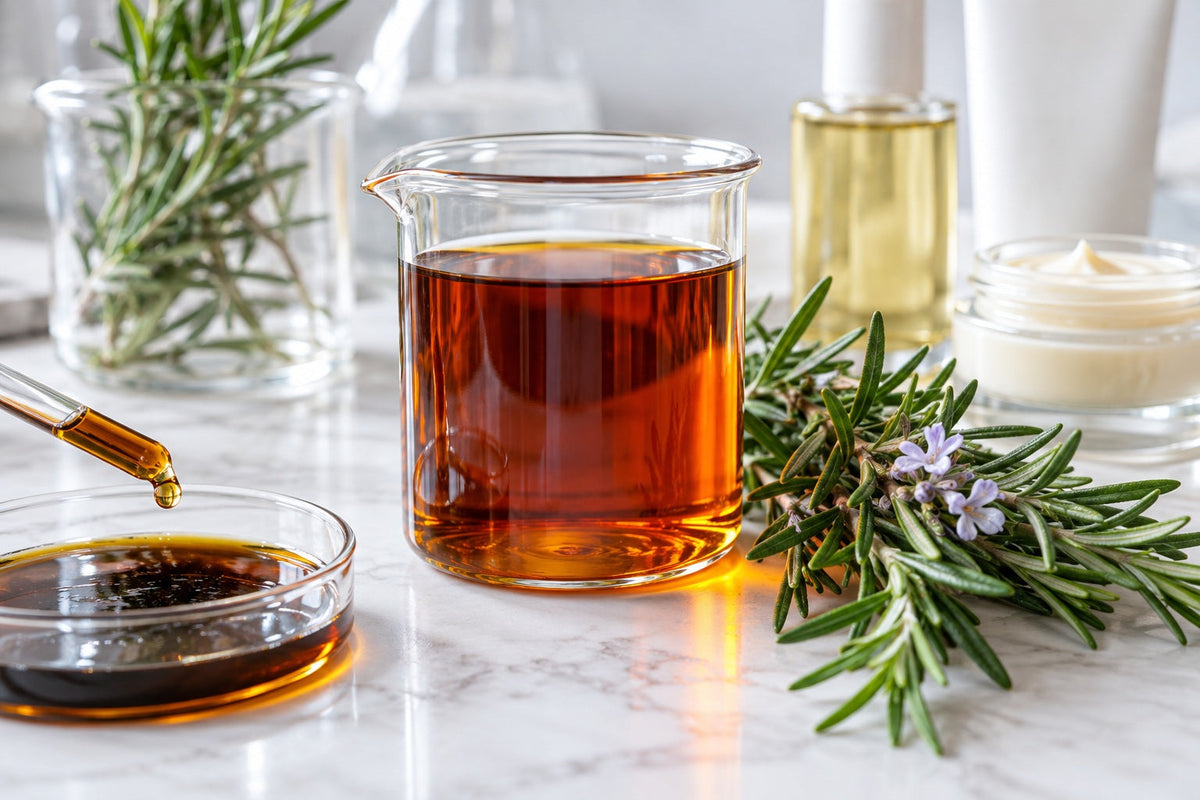
Rosemary oleoresin extract is a concentrated extract of rosemary leaves, carried in an oil base, and listed on a label as Rosmarinus Officinalis (Rosemary) Leaf Extract or a closely related INCI name depending on the supplier's material. Its antioxidant activity is associated with compounds in the extract, notably carnosic acid. The material itself is typically dark, viscous, and strongly herbal in character — a working ingredient, not a fragrance, even though it comes from an aromatic plant.
That distinction matters twice over. First, rosemary oleoresin is not rosemary essential oil: the essential oil is the volatile, scent-forward distillate, while the oleoresin is the heavier extract used at low levels to protect oils. Second, at normal use levels its job is protection, not perfuming — a formula that smells noticeably of rosemary because of its antioxidant was dosed by enthusiasm, not by need.

Rosemary oleoresin extract in formulation: what it actually does
It slows rancidity in the oil phase
Unsaturated plant oils oxidize with exposure to air, heat, and light, producing the stale, sharp off-odors customers read as "old product." Rosemary oleoresin helps interrupt that oxidation process in the oil phase, extending the period in which a body oil, face oil, or butter smells and feels like the approved sample. It delays oxidation; it does not reverse rancidity that has already occurred, and it does not make a fragile formula immortal.
It supports delicate, premium oil blends
The oils founders pay most for — the characterful, unsaturated, story-rich oils — are often the oils most vulnerable to oxidation. An antioxidant strategy is what lets a brand build a formula around those oils with a realistic shelf life. Rosemary oleoresin is frequently chosen for this role in naturally positioned products, and it is commonly paired with tocopherol, vitamin E, as part of a broader protection plan rather than as a single line of defense.
It works at low levels — which is the discipline
Effective use is measured and base-specific. The right level depends on how oxidation-prone the oil blend is, the packaging, and the target shelf life. More is not automatically better: excess can contribute color and herbal character a delicate scent profile never asked for. This is a formulator's dial, not a marketing percentage to print on the front label.
The distinction that protects your brand: antioxidant is not preservative
Read this part carefully, because it is the most consequential sentence in this post for a new founder: rosemary oleoresin extract does not preserve a product against bacteria, yeast, or mold. In an anhydrous product — a pure oil, a balm, a butter with no water phase — microbial risk is inherently low and oxidation is the main enemy, which is exactly the territory where this ingredient shines. In any water-containing product — a body wash, a lotion, a foaming cleanser — a dedicated preservative system and preservative efficacy testing are required, and no antioxidant, however natural its story, substitutes for them. Brands that blur this line are not being clever; they are shipping unprotected product.
Where rosemary oleoresin extract earns its place
- Body oils and scented body oils — protecting the carrier blend that carries the fragrance.
- Face oils — guarding delicate, unsaturated oils through a long, drop-by-drop use period.
- Body butters and balms — protecting the oil phase in anhydrous products judged by scent at every opening.
- Massage oils — larger bottles, longer open time, and a scent profile that has to stay true.
- Sugar scrubs — protecting the oil system that coats the exfoliant and meets the customer first by smell.
Packaging and process are the other half of the plan
An antioxidant is one layer, not the whole strategy. Air-restricting, light-protective packaging, sensible fill and storage practices, and fresh, well-handled raw oils all do part of the work. A founder who specifies rosemary oleoresin and then packages a delicate oil in a clear, wide-mouth jar has bought protection and then opened the door to the problem. Decide the antioxidant, the package, and the shelf-life target together, and confirm the combined plan with stability testing rather than hope.
Keep reading
- Vitamin E: the antioxidant that protects your formula
- High oleic sunflower oil: the stable workhorse behind oils that last
How we approach it
At Simplicity Filling Systems, oxidation questions start with the actual oil blend, the package, and the shelf life you need to stand behind — then the antioxidant plan follows from those facts. As a full turnkey partner, start to sold, we carry ingredient sourcing, manufacturing, bottling and packaging, fulfillment, and website and marketing support — across perfumes, body washes, sugar scrubs, body oils, massage oils, beach body oil, deodorant, beard oil, and hair oil, with creams filled and packaged through our production partners. Small runs welcome, startups welcome, built to scale. Comparing quotes? Show us a comparable written quote — we'll match it or beat it.
Frequently asked questions
Is rosemary oleoresin extract a preservative? No. It is an antioxidant that helps slow oxidation and rancidity in oils. It does not protect against bacteria, yeast, or mold. Water-containing products need a dedicated preservative system and preservative efficacy testing.
Is rosemary oleoresin the same as rosemary essential oil? No. Rosemary essential oil is the volatile distillate used for scent. Rosemary oleoresin is a concentrated leaf extract used at low levels to protect the oil phase. They come from the same plant and do entirely different jobs.
Will it make my product smell like rosemary? At measured, appropriate levels in most oil systems, its scent contribution is minimal — protection is its job, not fragrance. Excessive levels can add color and herbal character, which is one reason dosing follows the base, not a copied percentage.
Can it rescue oil that already smells rancid? No. Oxidation that has already happened cannot be undone. Rosemary oleoresin helps delay oxidation in a fresh, well-handled formula, alongside protective packaging and sensible storage.
Rosemary oleoresin or vitamin E — which do I need? Often both, doing related work as part of one antioxidant plan. The choice and level depend on the specific oils, how unsaturated they are, the packaging, and the shelf-life target — which is why the plan is built from the formula, not from a generic recipe.
The bottom line
Rosemary oleoresin extract is shelf-life insurance for the products customers judge by smell: it quietly slows the oxidation that turns a good oil stale, while never pretending to be a preservative. Dose it for your actual blend, pair it with protective packaging, and verify with stability work.
Making an oil, butter, or scrub that has to smell as fresh in month six as it did at filling? Contact us and tell us about the product. We will give you a straight answer on the formula, the packaging, and the run that proves it.
Simplicity Filling Systems — private-label and contract manufacturing in Sunrise, FL. Small runs welcome, startups welcome, built to scale.
Ready for your number?
Run your specs through our Quote Builder for an instant online quote — or reach out for a custom quote.
More from News

PEG-150 Distearate: The Thickener Founders Add Cold, Dose by Hope — and Then Blame When the Wash Stays Thin
Sodium Cocoyl Isethionate: The Gentle Cleanser Founders Expect to Pour Like Water — and Then Blame When the Bar Turns Gritty
