
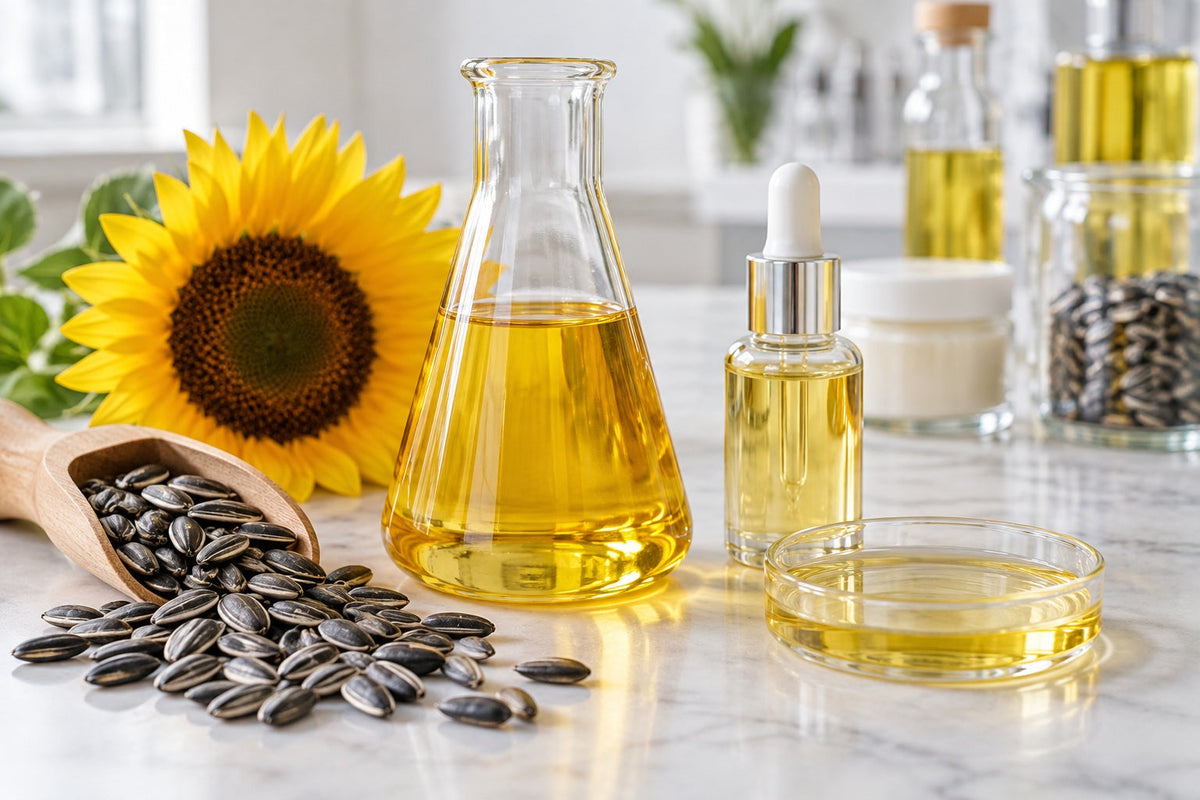
Your body oil smelled clean when you filled it, looked clear on the shelf, and then — a few months in — developed that stale, tired note customers describe without knowing the word for it. Often the problem is not the fragrance. It is the carrier oil underneath it, oxidising quietly from the day the bottle was filled. High oleic sunflower oil exists to solve exactly that problem, and understanding why it behaves differently from regular sunflower oil is what lets a founder choose it on purpose instead of by accident.
What "high oleic" actually means
All sunflower oil comes from sunflower seeds, but not all sunflower oil has the same fatty acid profile. Regular, conventional sunflower oil is typically higher in linoleic acid, a polyunsaturated fatty acid. High oleic sunflower oil comes from sunflower varieties bred so the oil is predominantly oleic acid — a monounsaturated fatty acid — instead.
That difference drives almost everything a formulator cares about. Polyunsaturated oils oxidise more readily in air, heat, and light; a predominantly monounsaturated oil oxidises more slowly. In plain terms, high oleic sunflower oil gives a finished product a better chance of smelling and feeling like itself for longer. List it honestly by its proper ingredient name — "high oleic" is a specification you buy to, not a claim to inflate on the front of a bottle.
Why stability is the headline benefit
Oxidation is the slow failure behind many returns founders misread as fragrance complaints. As an oil oxidises, its odour changes and the whole product shifts — the body oil feels less clean, the massage oil less fresh.
Shelf life without drama
In leave-on products that live in bathrooms and warm retail shelves, a more oxidation-resistant base buys time the honest way. It does not replace sensible packaging, storage, or stability testing in the real container — it means those measures protect a formula built to last.
A neutral stage for fragrance
High oleic sunflower oil has a relatively neutral character, which is why it appears so often underneath scented products. A carrier with little competing odour lets fragrance in a body oil, beach body oil, or massage oil read as intended. When a scented oil "smells different" batch to batch, the carrier is one of the first places a formulator looks.
How it feels on skin — and where it fits
Founders also choose it for feel: a midweight, smooth-spreading oil with glide and a conditioned after-feel, without the heavier finish richer oils leave. That balance explains its range.
- Body oils and beach body oil — as a primary carrier, it spreads evenly, carries fragrance cleanly, and gives a finish customers describe as nourished rather than greasy when the overall formula is balanced.
- Massage oils — it provides the sustained glide massage work requires, without an odour that competes with the scent of the product.
- Creams and lotions — as part of the oil phase, it contributes emollience and spread to an emulsion while supporting a stable finished product.
- Face oils and serums — used thoughtfully within a balanced blend, it can serve as a dependable base oil alongside lighter esters or more characterful oils.
- Sugar scrubs and emulsified scrubs — it coats and carries the exfoliant, then needs to be balanced so the rinse and after-feel match the promise of the scrub.
No single oil makes a product. In many formulas it is the dependable majority of a blend, with smaller amounts of other oils added for a specific feel or story. The blend is the formulation work.
Sourcing and handling: where quality is decided
"High oleic" is a specification, so buy it like one. Confirm the oil you are sourcing is genuinely the high oleic type rather than conventional sunflower oil — the two are not interchangeable in a formula built around stability, and a substitution can quietly shorten the life of a product you have already tested. Keep supplier documentation with the batch, and record which oil went into which production batch, the same traceability discipline that applies to any ingredient.
Store it sealed, away from heat and light, and treat an oil that already smells tired on arrival as a rejected ingredient, not a problem fragrance can cover. Antioxidant support helps a sound oil; it cannot rescue one that arrived oxidised.
Finally, test the finished product, not just the raw material — in the actual bottle, with the actual closure, over time. A stable ingredient in an unsuitable bottle is still an unstable product.

Cost and positioning, honestly
High oleic sunflower oil is widely available and generally a practical, workhorse ingredient rather than a rare luxury oil. That is a strength: a small brand can build a stable, well-feeling product without resting the whole formula on a fragile or expensive base. Position the product on what the customer experiences — how it spreads, finishes, and smells months after opening. Do not build claims the oil cannot carry; present it in appearance and feel terms, and leave medical language out entirely.
How we approach it
At Simplicity Filling Systems, carrier oils are chosen as specifications, not commodities: the high oleic type confirmed at sourcing, batch documentation kept, and the finished product stability-tested in its real packaging. As a full turnkey partner, start to sold, we carry ingredient sourcing, manufacturing, bottling and packaging, fulfilment, and website and marketing support — across body oils, massage oils, beach body oil, creams, sugar scrubs, face oils, perfumes, body washes, deodorant, supplements, and body butter. Small runs welcome, startups welcome, built to scale. Comparing quotes? Show us a comparable written quote — we'll match it or beat it.
Frequently asked questions
What is the difference between high oleic sunflower oil and regular sunflower oil? Regular sunflower oil is typically higher in linoleic acid, while high oleic sunflower oil is predominantly oleic acid, a monounsaturated fatty acid that oxidises more slowly — supporting better stability in a finished product.
Why does oxidation matter in a body oil or cream? As an oil oxidises, its odour and colour change and the product's experience shifts. Starting with a more oxidation-resistant oil helps it stay true to itself for longer.
Does high oleic sunflower oil feel heavy on skin? It is generally experienced as midweight and smooth-spreading — enough glide and after-feel to condition, without the slowest, heaviest finish. The overall feel still depends on the full blend it is part of.
Can it be used in scented products? Yes, and its relatively neutral character is one reason it is chosen for scented body oils, massage oils, and beach body oil: a quiet carrier lets the fragrance read as intended.
Does using a stable oil remove the need for stability testing? No. It improves the starting position, but the finished product must still be tested in its actual packaging over time. The product, not the raw material alone, is what the customer buys.
The bottom line
High oleic sunflower oil earns its place the unglamorous way: a profile that resists oxidation better than conventional sunflower oil, a neutral character that lets fragrance perform, and a balanced feel across body oils, massage oils, creams, and scrubs. Specify it, store it, and test the finished product properly.
Thinking about a body oil, massage oil, or cream built on a stable carrier? Contact us and tell us the product you are building, the feel you want, and the scent direction. We will give you a straight answer on the oil blend, the packaging, and the run that proves it.
Simplicity Filling Systems — private-label and contract manufacturing in Sunrise, FL. GMP facility, 18+ years. Small runs welcome, startups welcome, built to scale.*
Ready for your number?
Run your specs through our Quote Builder for an instant online quote — or reach out for a custom quote.
More from News

PEG-150 Distearate: The Thickener Founders Add Cold, Dose by Hope — and Then Blame When the Wash Stays Thin
Sodium Cocoyl Isethionate: The Gentle Cleanser Founders Expect to Pour Like Water — and Then Blame When the Bar Turns Gritty
