
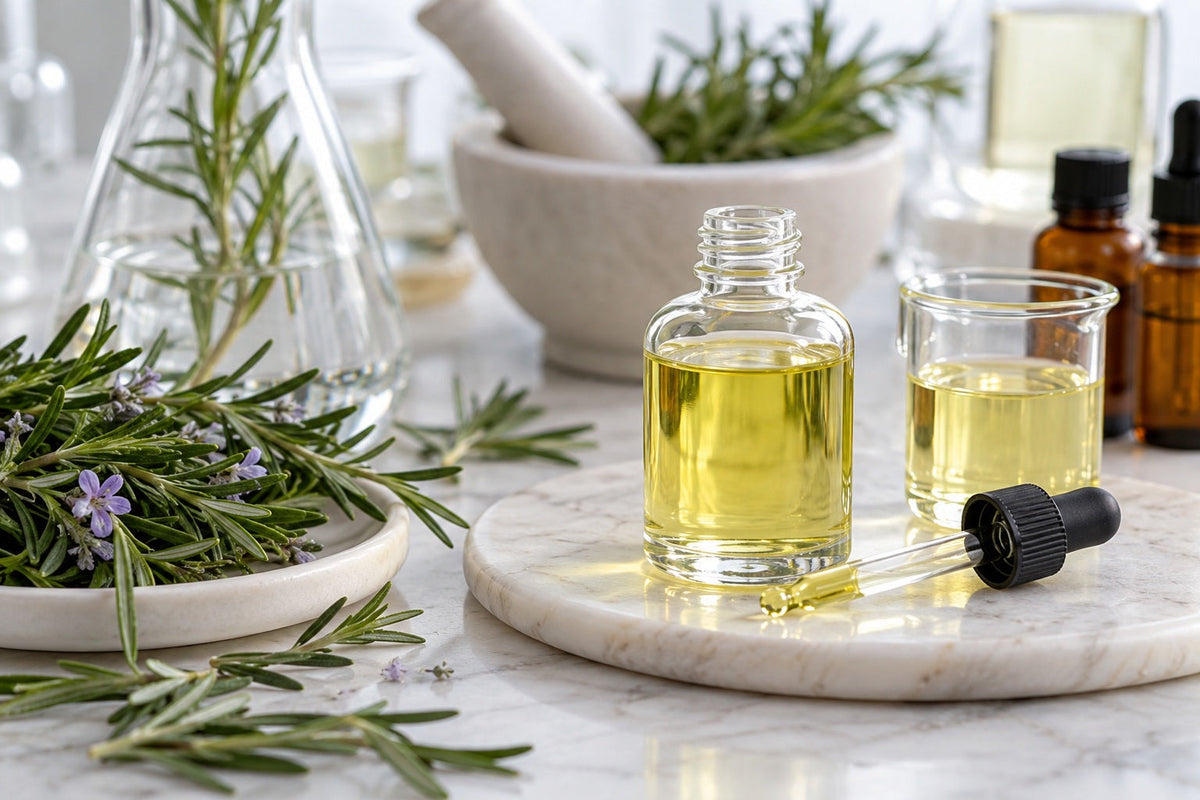
A founder smells rosemary essential oil in a formula and immediately thinks the product is protected, natural, and finished. Then the scent fades in the bottle, sharpens in a hot warehouse, or overpowers a delicate blend — and the reviews say the second bottle smelled nothing like the first. Rosemary essential oil is a real, useful cosmetic ingredient, but only when you respect what it actually is: a volatile, scent-forward distillate with a short temper and a specific job.
It is not the antioxidant from the last post in this series. It is not a preservative. And it is not a free pass to make scalp, hair, or skin claims no cosmetic can carry. Get those three distinctions right and rosemary essential oil earns its place. Get them wrong and it becomes the most expensive way to learn volatility.
What rosemary essential oil actually is
Rosemary essential oil is obtained by steam distillation of the leaves and flowering tops of Rosmarinus officinalis. On a cosmetic label it appears as Rosmarinus Officinalis (Rosemary) Leaf Oil. Unlike rosemary oleoresin extract — the dark, heavy, low-dose antioxidant used to slow rancidity in oils — the essential oil is made of volatile aromatic compounds that evaporate readily. That volatility is the whole point for scent, and the whole risk for stability.
Composition varies with origin, harvest, and chemotype, so two drums labelled the same can smell noticeably different. A serious brand locks a supplier and an approved scent sample, then holds reorders to it.
Rosemary essential oil in cosmetics: what it actually does
It delivers an herbal, camphoraceous scent customers recognise instantly
Rosemary reads clean, herbal, and slightly medicinal in the best sense — the scent of a scalp ritual, a focused morning wash, and a product that feels purposeful rather than perfumed. That recognition is valuable in hair oils, beard oils, body washes, and scrubs where a founder wants a botanical direction without a sweet floral profile.
It is a scent ingredient first — dose it like one
Because the aromatic compounds are volatile and potent, a little carries a long way and a little too much dominates everything around it. The right level is set by the product type, the base it sits in, the other fragrance components, and current supplier and IFRA guidance for that category — not by copying a percentage from a blog or a competitor's label. Leave-on and rinse-off products are different decisions. A scalp oil that sits for hours is not dosed like a body wash that rinses in a minute.
It does not protect oils, preserve water, or treat anything
Say this plainly in your own brief before anyone writes label copy: rosemary essential oil does not stop a carrier oil from going rancid — that is the oleoresin's job, supported by vitamin E and protective packaging. It does not preserve a water-containing product against bacteria, yeast, or mold — that requires a dedicated preservative system and preservative efficacy testing. And a cosmetic containing it may not claim to regrow hair, treat dandruff as a disease, cure scalp conditions, or deliver a drug outcome. Cosmetic language stays in appearance and experience: hair that looks fuller, a scalp that feels refreshed and comfortable, a cleaner-feeling rinse.
The handling problems founders underestimate
Volatility means the top of the scent leaves first. A formula approved fresh can smell flatter months later if the packaging lets vapour escape or the product is stored hot. Oxidation is the second trap: essential oils exposed to air, light, and heat can change character and become more sensitising in feel, which is why fresh stock, tight closures, sensible fill practices, and stability testing matter more for an essential-oil product, not less. The third trap is separation and solubility — an essential oil stirred into a water base without a proper solubilisation or emulsification plan will float, cloud, or dose unevenly from bottle to bottle.
None of these are reasons to avoid it. They are reasons a kitchen bench sample is not proof a production run will hold.

Where rosemary essential oil earns its place
- Hair oils — an herbal signature in an oil system judged by scent at every use.
- Beard oils — a clean, non-sweet direction that pairs with woody and citrus notes.
- Body washes and foaming cleansers — a refreshing rinse-off scent, in a properly preserved, properly solubilised water system.
- Sugar scrubs — a bright herbal counterpoint in an oil-based scrub, protected separately against oxidation.
- Massage oils — a purposeful, spa-recognisable aroma in a larger bottle that must stay true over a long open life.
What to decide before you brief a run
Decide the supplier first, and approve a scent standard you can hold reorders to. Decide the category and dose second, using current category guidance, because leave-on and rinse-off are not interchangeable. Decide the antioxidant and preservation plans separately — never let an essential oil stand in for either one. Write the claims last, in cosmetic language, from the finished formula.
Keep reading
- Rosemary oleoresin extract: the antioxidant that keeps oils from going rancid
- Hair oil: the finish customers judge in the mirror
How we approach it
At Simplicity Filling Systems, a rosemary project starts by separating the three jobs founders blur together — scent, antioxidant protection, and preservation — and giving each one its own real answer. As a full turnkey partner, start to sold, we carry ingredient sourcing, manufacturing, bottling and packaging, fulfillment, and website and marketing support — across perfumes, body washes, sugar scrubs, body oils, massage oils, beach body oil, deodorant, beard oil, and hair oil, with creams filled and packaged through our production partners. Small runs welcome, startups welcome, built to scale. Comparing quotes? Show us a comparable written quote — we'll match it or beat it.
Frequently asked questions
Is rosemary essential oil the same as rosemary oleoresin extract? No. The essential oil is the volatile steam distillate used for scent. The oleoresin is a concentrated leaf extract used at low levels as an oil-phase antioxidant. Same plant, different materials, different jobs.
Can rosemary essential oil preserve my product? No. It is not a preservative system. Any water-containing product needs a dedicated preservative system and preservative efficacy testing, regardless of which essential oils it contains.
Can I claim rosemary oil regrows hair? No. That is a drug claim. A cosmetic can describe appearance and experience — hair that looks thicker, a scalp that feels refreshed — not regrowth, treatment, or cure.
Why did my rosemary scent fade or change? Volatile aromatics evaporate and oxidise with air, light, and heat. Tight, protective packaging, fresh stock, sensible storage, and stability testing are how a brand keeps month six smelling like the approved sample.
How much rosemary essential oil should I use? There is no universal percentage to copy. The level depends on product type, leave-on or rinse-off use, the base, the rest of the fragrance blend, and current supplier and IFRA guidance for that category. Set it in formulation, not from a headline.
The bottom line
Rosemary essential oil is a distinctive, recognisable scent ingredient that rewards discipline: lock the material, dose it for the category, protect the formula by other means, and keep the claims cosmetic. Do those four things and it gives a hair oil, wash, or scrub a signature customers remember for the right reasons.
Building a rosemary-scented product and want the scent, stability, and claims checked before you print? Contact us and tell us about the product. We will give you a straight answer on the formula, the packaging, and the run that proves it.
Simplicity Filling Systems — private-label and contract manufacturing in Sunrise, FL. Small runs welcome, startups welcome, built to scale.
Ready for your number?
Run your specs through our Quote Builder for an instant online quote — or reach out for a custom quote.
More from News

PEG-150 Distearate: The Thickener Founders Add Cold, Dose by Hope — and Then Blame When the Wash Stays Thin
Sodium Cocoyl Isethionate: The Gentle Cleanser Founders Expect to Pour Like Water — and Then Blame When the Bar Turns Gritty
