
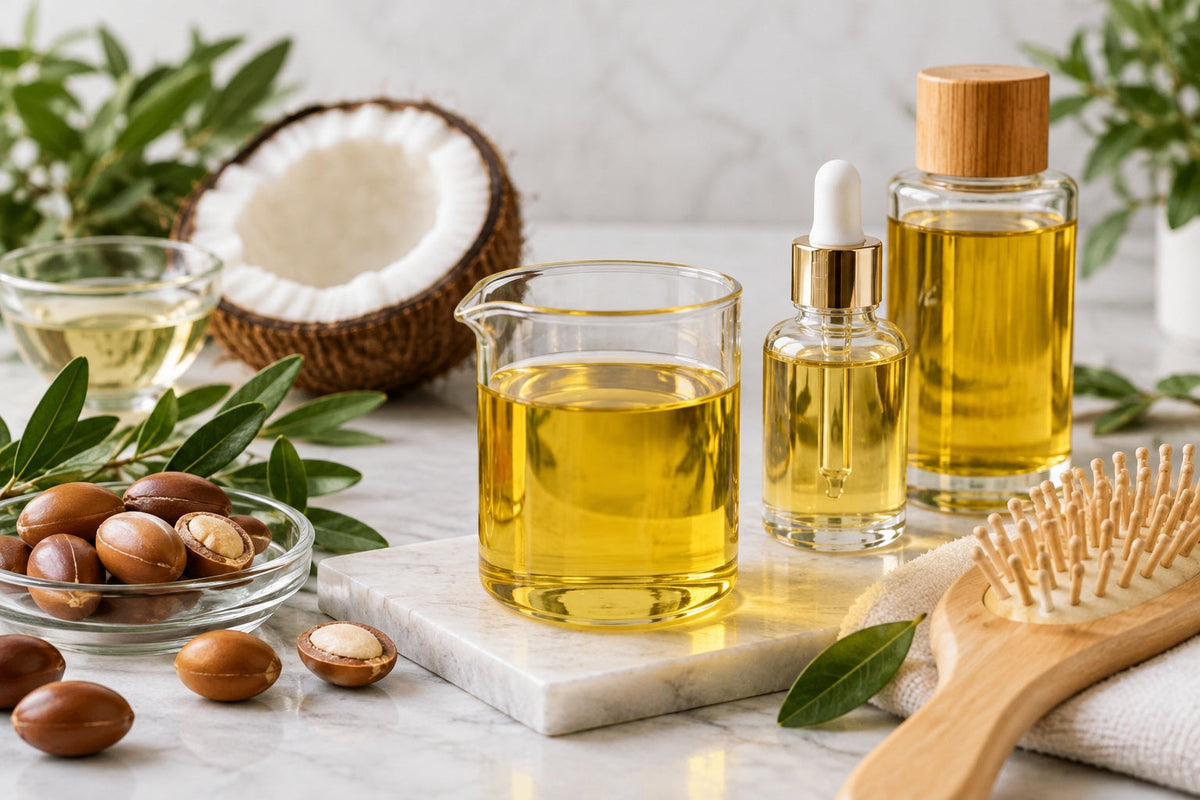
Hair oil has about five seconds to prove itself. The customer warms a few drops between her palms, runs them through the ends of her hair, and looks in the mirror. Either the hair looks smoother, glossier, and more finished — or it looks stringy, weighed down, and in need of another wash. There is almost no middle ground, and no label copy survives that mirror test. That is why hair oil rewards founders who build carefully for hair type, dose, and finish — and punishes anyone who treats it as scented oil in a pretty bottle.
What hair oil does — honestly
A hair oil is a leave-on product applied in small amounts, most often to the mid-lengths and ends. Its cosmetic jobs are to smooth the look of frizz and flyaways, add shine, soften how dry ends feel, and make hair look more finished and cared-for between washes.
Keep the promise there. Hair oil improves appearance and feel; it does not repair hair, and split ends are a trimming problem, not an oil problem. Brands that say the honest thing earn the repeat purchase. Brands that promise transformation earn the disappointed review.
Ends first: where the product belongs
The single most common hair oil failure is placement, and founders can design against it.
Ends are the oldest, driest part of the hair — washed, brushed, and weathered the longest, they show dryness first. Roots sit next to the scalp's own oils and rarely need more. So teach a simple ritual: a few drops, warmed in the palms, worked through mid-lengths and ends. "Apply to hair" is not a direction. Teach placement and starting dose, and the first mirror test goes as intended.

Weight is the whole game
Every hair oil decision comes back to one question: how much weight does this blend leave behind?
Fine hair exposes everything
On fine hair, a heavy hand or a heavy blend collapses volume and reads instantly as greasy. Fine hair needs a light blend, a small dose, and honest guidance that less is the starting point — with permission to add a drop, never the reverse.
Thick, coarse, and curly hair can carry more
Denser, coarser hair — and many curly textures — can absorb and benefit from richer application, especially through dry ends. The same blend that overwhelms fine hair may be exactly right here. That is not a contradiction; it is a segmentation decision. Some brands solve it with one carefully balanced middle-weight oil and clear dosing by hair type. Others build a light and a richer version and let customers self-select. Either route works — pretending hair type does not matter does not.
Shine without the string effect
Shine should look like light moving across healthy-looking hair, not like oil sitting on it. When hair separates into strings, the dose or the weight is wrong for that hair. Wear-test your final blend across hair types at realistic doses, in daylight, hours after application — because a finish that looks perfect at minute five can look heavy by lunch.
Dry hair, damp hair, and styling routines
Customers use hair oil at different moments: on dry hair as a finishing step, on damp hair after washing before drying, or as a more generous pre-wash treatment left on before shampooing. You do not need to claim all three. Pick the uses your blend actually performs in, test them, and print those. One use performed beautifully beats three performed adequately.
Scent and the hair as a carrier
Hair holds scent well — which cuts both ways. A beautiful fragrance gets noticed in close conversation, making hair oil an effective scent vehicle. An overbuilt one becomes inescapable and competes with perfume all day. Build for closeness, test worn in hair for a full day, and consider coordinated scent families across hair oil, body oil, and perfume — an honest reason to own more than one product.
Packaging for a product used drop by drop
Dose control is packaging's job. Droppers and controlled pumps serve hair oil well when they deliver small, repeatable amounts — the difference between perfect and too much can be two drops. A package that glugs or cannot be handled with oily palms will be fought with daily, and the formula will be blamed. Labels must survive oil contact and closures must not weep in a warm bathroom. Test the finished bottle through weeks of real use, not just on approval day.
Building hair oil into a wider line
Hair oil pairs naturally with a wider range — at SFS that includes perfumes, body washes, creams, sugar scrubs, body oils, massage oils, beach body oil, deodorant, body butters, and supplements, plus beard oil. The strategic point is routine ownership: a finishing product used several times a week, judged in the mirror every time, creates more brand impressions per bottle than almost anything else on the shelf.
How we approach it
At Simplicity Filling Systems, hair oil is formulated and filled to the mirror-test standard: weight balanced and wear-tested across hair types, dose and placement guidance written for a first-time user, scent tested in hair across a full day, and packaging checked for dose control and oil resistance in real use. As a full turnkey partner, start to sold, we can carry the work through ingredient sourcing, manufacturing, bottling and packaging, fulfillment, and website and marketing support. Small runs welcome, startups welcome, built to scale. Comparing quotes? Use our price-match promise: show us a comparable written quote — we'll match it or beat it.
Frequently asked questions
How much hair oil should a customer start with? A few drops, warmed between the palms and worked through mid-lengths and ends. Fine hair starts smallest. It is always easier to add a drop than to wash out an excess — directions should say so plainly.
Why does hair oil make some hair look greasy? Usually weight or dose: too heavy a blend for that hair type, too much product, or application too close to the roots. Match blend weight to the hair you are building for and teach ends-first placement.
Should hair oil go on wet or dry hair? Both are legitimate uses with different finishes — damp application as part of the wash-day routine, dry application as a finishing gloss. Test and recommend the moments your specific blend performs best in.
Can hair oil fix split ends? No — and say so. Oil can smooth how ends look and feel, but split ends are removed by trimming. Honest guidance like this is what makes customers believe your other claims.
What packaging suits hair oil best? Any format that delivers small, controlled, repeatable doses — commonly a dropper or controlled pump — with oil-resistant labelling and a closure that does not weep. Test it with oily hands, in a warm bathroom, over weeks.
The bottom line
Hair oil is a five-second mirror judgement repeated several times a week. Pass it with the right weight for the hair, ends-first dosing a beginner can follow, scent built for closeness, and packaging that controls every drop — and keep every claim inside what the product honestly does. That combination turns a simple oil into a routine, and a routine into repurchase.
Thinking about a hair oil for your line? Contact us and tell us the hair types you are building for, the finish you want, and where it sits in your range. We will give you a straight answer on the blend, the bottle, and the run that proves it.
Simplicity Filling Systems — private-label and contract manufacturing in Sunrise, FL. GMP facility, 18+ years. Small runs welcome, startups welcome, built to scale.*
Ready for your number?
Run your specs through our Quote Builder for an instant online quote — or reach out for a custom quote.
More from News

PEG-150 Distearate: The Thickener Founders Add Cold, Dose by Hope — and Then Blame When the Wash Stays Thin
Sodium Cocoyl Isethionate: The Gentle Cleanser Founders Expect to Pour Like Water — and Then Blame When the Bar Turns Gritty
