
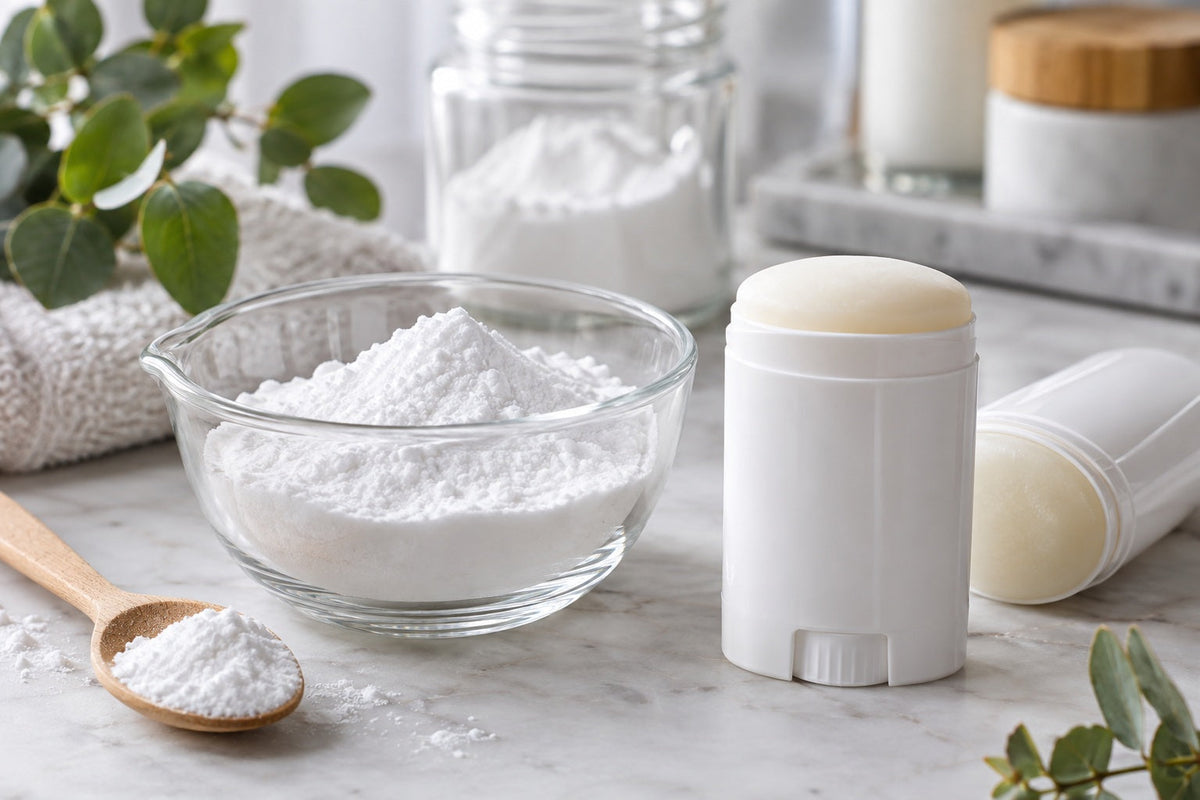
Few ingredients split a review page like baking soda in deodorants. Half the customers call it the only thing that ever worked. The other half post a photo of an angry, red underarm and swear off the brand for good. Both reactions usually come from the same formula decision: baking soda dosed for maximum odour control on day one, with no honest plan for what that alkalinity does to skin on day fourteen. The ingredient did not betray anyone. The dose did.
Used at a level skin can live with, and supported by the rest of the system, baking soda is a direct, dependable odour neutraliser for aluminium-free deodorant. Used as a blunt instrument, it earns the rash complaints that bury an otherwise good product.
What baking soda actually is
On a cosmetic label, baking soda appears as Sodium Bicarbonate. It is a white mineral powder, mildly alkaline — about pH 8.3 in a 1% water solution. Underarm odour is not sweat itself. Sweat is largely odourless when it leaves the body; odour develops when skin bacteria break sweat down into acidic, volatile compounds. An alkaline material neutralises many of those acidic odour compounds as they form, converting them into less volatile, less noticeable salts. That neutralisation is baking soda's real job in a deodorant.
It is not an antiperspirant. It does not plug sweat glands or reduce sweat output, and a deodorant built on it must not claim that it does. It also is not a preservative, a sweat absorber on its own, or a fragrance. Starches absorb surface moisture, fragrance shapes the scent experience, and baking soda neutralises odour — three different jobs that founders routinely collapse into one ingredient and then blame when the stick underperforms.
Baking soda in deodorants: the decisions that decide the reviews
Neutralisation is the strength — and the limit
Baking soda works because it reacts. That is also why more is not automatically better. Once the acidic odour compounds present have been neutralised, extra alkalinity has nowhere useful to go. It sits against skin whose natural surface is mildly acidic — the acid mantle sits roughly around pH 4.5 to 5.5 — and repeated, prolonged contact at a much higher pH can leave skin dry, itchy, or irritated for some users, especially after shaving or in heat and friction.
That makes it a dosed ingredient. Set the level against two tests at once: does the stick still control odour late in a real day, and does the same underarm still feel comfortable after consecutive days? A formula that passes only the first test is a returns problem waiting for warm weather.
Level, particle feel, and dispersion decide comfort
Baking soda that is poorly dispersed drags and feels gritty, and grit in an underarm product reads as careless before the customer can judge odour control at all. Particle size, how the powder is wetted into the base, and how evenly it is distributed through the stick all decide whether application feels smooth or scratchy.
Balance matters in the other direction too. Cutting the level sharply to chase a "baking soda gentle" story, without giving the odour work to anything else, produces the opposite review: comfortable, and useless by noon. If the level comes down, something else in the system — another odour-control material, the starch phase, the fragrance structure — has to be deliberately redesigned to carry the load. Wishful thinking is not a system.
The baking-soda-free question has to be answered honestly
Some customers seek baking-soda-free deodorant because they know their skin reacts. Serving them means a separate formula — not the same stick with the level quietly lowered. And when a customer does react, answer plainly: irritation is a known possibility at the wrong level for that person. A brand that answers honestly keeps the customer. A brand that argues loses them.

Where baking soda earns its place
- Aluminium-free deodorant sticks — as the neutralising core of the odour system, dosed against both wear and comfort tests.
- Cream and paste deodorants — where the dose per use can be directed on the label and the powder can be dispersed smoothly.
- Deodorant powders and dry formats — where neutralisation and surface dryness work together and reapplication is expected.
Stability, structure, and packaging are not footnotes
Baking soda reacts with acids and moisture. In the wrong company, or a pack that lets humidity in, that shows up as texture change, scent drift, or a stick that no longer applies like the first batch. Test the finished product in its real pack after heat exposure, and check glide, residue, and odour performance together — not just appearance on filling day.
What to decide before you brief a run
Decide the promise first — odour control, with no antiperspirant language. Decide the level second, tested for full-day odour control and consecutive-day comfort. Decide the support system third: what absorbs moisture and what carries scent if the level comes down. Write claims last, from what those tests showed.
Keep reading
- Deodorant Sticks: the daily product that has to work without being noticed
- Magnesium Hydroxide: the deodorant workhorse founders expect to stop sweat
How we approach it
At Simplicity Filling Systems, a baking soda deodorant project starts with the level, the dispersion, and the wear-and-comfort test side by side, then checks claims before any label is printed. As a full turnkey partner, start to sold, we carry ingredient sourcing, manufacturing, bottling and packaging, fulfillment, and website and marketing support — across perfumes, body washes, creams, sugar scrubs, body oils, massage oils, beach body oil, deodorant, body butter, beard oil, and hair oil. Small runs welcome, startups welcome, built to scale. Comparing quotes? Show us a comparable written quote — we'll match it or beat it.
Frequently asked questions
Does baking soda stop sweat? No. Baking soda neutralises acidic odour compounds as they form. It does not reduce sweat output, and a deodorant built on it should not be marketed as an antiperspirant.
Why do some people get irritation from baking soda deodorant? Baking soda is alkaline, around pH 8.3 in a dilute solution, while the skin surface is mildly acidic. At too high a level, or for a sensitive user, repeated contact can leave skin dry or irritated. Level, dispersion, and consecutive-day wear testing are how a formula manages that risk honestly.
Is a lower baking soda level always gentler and just as effective? Gentler, often. Just as effective, not automatically. If the level comes down, the rest of the odour system has to be redesigned to carry the work, and the finished product has to be retested.
What is the difference between a baking soda and a baking-soda-free deodorant? The odour system. A baking-soda-free formula is a different design that gives neutralisation and odour control to other materials. It is not the same formula with one powder removed.
Why does my deodorant feel gritty? Dispersion and particle feel are the first suspects. Powder that is not properly wetted and distributed through the base will drag, whatever the formula says on paper.
The bottom line
Baking soda rewards founders who respect both sides of it — real neutralising power, and a real comfort limit to dose and test, not market away. Get both right and the product works, and skin can stay with it.
Planning a deodorant and want the level, wear test, and claims checked before the label is printed? Contact us and tell us about the product. We will give you a straight answer on the formula, the packaging, and the run that proves it.
Simplicity Filling Systems — private-label and contract manufacturing in Sunrise, FL. Small runs welcome, startups welcome, built to scale.
Ready for your number?
Run your specs through our Quote Builder for an instant online quote — or reach out for a custom quote.
More from News

PEG-150 Distearate: The Thickener Founders Add Cold, Dose by Hope — and Then Blame When the Wash Stays Thin
Sodium Cocoyl Isethionate: The Gentle Cleanser Founders Expect to Pour Like Water — and Then Blame When the Bar Turns Gritty
