
Every natural-positioned deodorant lives or dies on one morning: the customer applies it, gets dressed, and decides by noon whether they trust it again. That pressure pushes founders to ask one ingredient to do two jobs. Magnesium hydroxide is brought in to help with odour, then marketed as if it also stops sweat — and when the customer sweats, as bodies do, they call the product a failure even if it handled odour exactly as designed. The formula did not fail first. The expectation did.
Dosed properly, magnesium hydroxide is a dependable odour-control foundation: steady, comparatively gentle in feel for many users, and well suited to aluminium-free positioning — as long as nobody promises it is an antiperspirant.
What magnesium hydroxide actually is
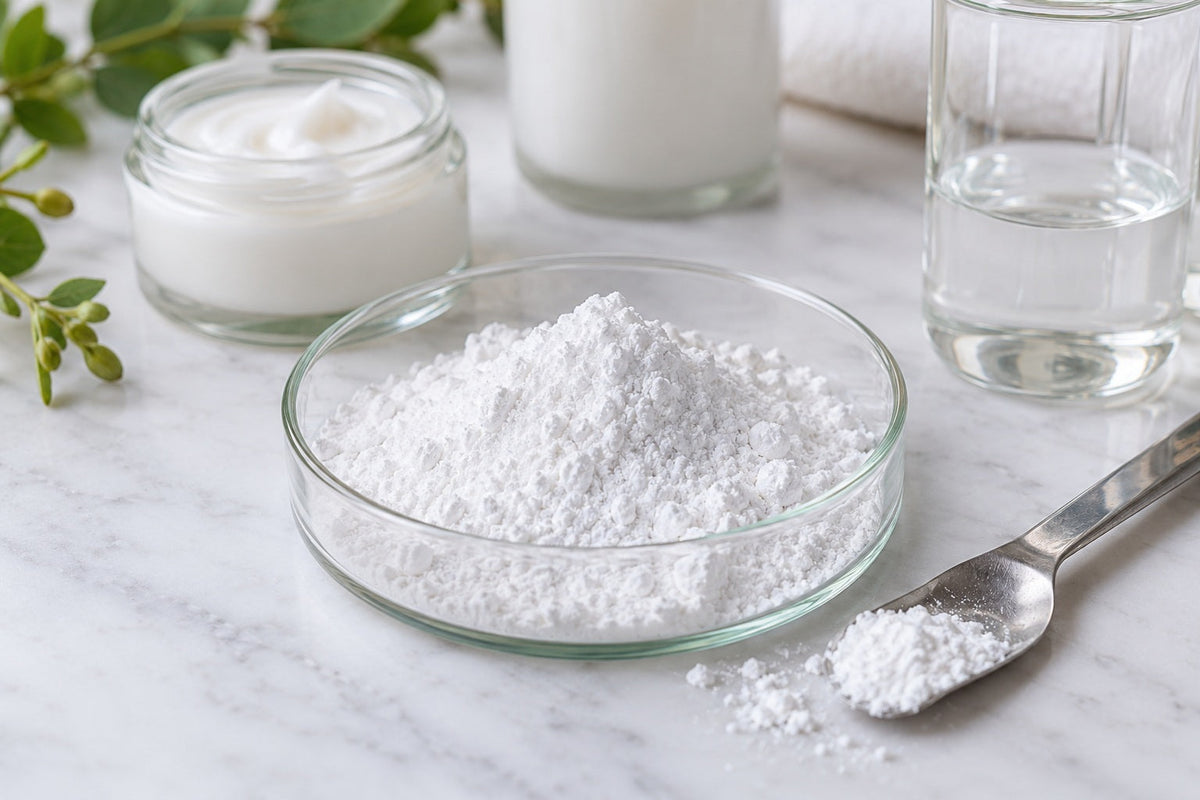
On a cosmetic label, magnesium hydroxide appears as Magnesium Hydroxide. It is a mineral powder, mildly alkaline, used in deodorant formulas as part of the odour-control system. Odour in the underarm is largely a by-product of bacteria acting on sweat. A deodorant does not need to stop the sweat to address the smell; it needs to make the surface a less welcoming place for odour to develop and to neutralise acidic odour components as they form. That is the lane magnesium hydroxide works in.
It is not an antiperspirant active. It does not plug sweat glands or reduce sweat output the way an antiperspirant drug product is designed to, and a cosmetic deodorant built on it must not claim that it does. That distinction is not legal fine print to hide — it is the product promise to state plainly, because a customer told the truth rebuys, and a customer oversold does not.
Magnesium hydroxide in deodorant formulation: the decisions that decide trust
Odour control is the job — sweat reduction is not
This is the decision every brief has to make first. If the product is positioned as a deodorant, the honest promise is odour: you will still sweat, and the product is built to keep that sweat from turning into a smell that reaches the room. Copy that says "stops sweat," "keeps you dry all day" in the antiperspirant sense, or borrows clinical language invites complaints, platform pushback, and drug-claim risk. Copy that says the product helps control odour through the day — and is then built to actually do it — is both honest and sellable.
Support the core ingredient properly. Fragrance, starches for surface feel, and the rest of the odour system each have a part, but none of them rescues an under-dosed base. Decide what carries odour control, dose it as the system requires, and test the finished stick on real days — heat, movement, and a full workday — not on a wrist at the bench.
Dose and dispersion decide whether gentle also means effective
Magnesium hydroxide has a reputation for feeling gentler than harsher alkaline options, and founders sometimes protect that reputation by under-dosing until the product is pleasant and ineffective. The opposite error is just as real: loading powder without designing dispersion, so the stick drags, leaves grit, or delivers unevenly from the first swipe to the last.
Powder has to be wetted and distributed evenly through the base, and the level has to be checked against glide, residue, and odour performance together. A stick that feels smooth but fails by noon and a stick that works but feels like chalk are both failures — of balance, not of the ingredient. Specify the level, the dispersion process, and the test day, and write all three into the batch record.
pH and skin feel: alkaline enough to work, balanced enough to wear
Magnesium hydroxide is alkaline, and that alkalinity is part of how it does its job. It is also why balance matters. Skin that feels irritated will not blame pH; it will blame your brand, in a review, by name. The finished product has to be tested on underarm skin in real use — after shaving, in heat, over consecutive days — because that is the use that decides the rating. If irritation appears, the answer is formula work on the whole system, not a softer claim on the same stick.
Swapping or stacking alkaline materials changes both performance and feel, and each change restarts the wear test. There are no shortcuts that survive a Florida summer.

Where magnesium hydroxide earns its place
- Aluminium-free deodorant sticks — as the odour-control foundation, with glide, residue, and wear tested together.
- Cream and paste deodorants — where dispersion and scoop feel can be tuned closely, and directions set the dose per use.
- Fragranced and lighter-scent deodorant lines — where the odour system has to carry more of the work than the scent does.
Stability, structure, and packaging are not footnotes
A deodorant stick is a structured product: the powder lives inside a wax and oil system that has to hold its shape in a warm bathroom, glide without crumbling, and deliver evenly to the last turn of the dial. Stability testing should check hardness, glide, scent, and odour performance in the real pack after heat exposure — not just at room temperature on filling day.
What to decide before you brief a run
Decide the promise first — odour control, stated plainly, with no antiperspirant language. Decide the level and dispersion second, tested for glide and wear together. Decide the wear test third: real days, real heat, consecutive use. Write the claims last, from what that test actually showed.
Keep reading
- Deodorant Sticks: the daily product that has to work without being noticed
- Cosmetic Product Claims: what you can say, what you cannot, and why it matters
How we approach it
At Simplicity Filling Systems, a magnesium hydroxide deodorant project starts with the promise, the level, and the wear test side by side, then checks glide, residue, and claims before any label is printed. As a full turnkey partner, start to sold, we carry ingredient sourcing, manufacturing, bottling and packaging, fulfillment, and website and marketing support — across perfumes, body washes, creams, sugar scrubs, body oils, massage oils, beach body oil, deodorant, body butter, beard oil, and hair oil. Small runs welcome, startups welcome, built to scale. Comparing quotes? Show us a comparable written quote — we'll match it or beat it.
Frequently asked questions
Does magnesium hydroxide stop sweat? No. It is a deodorant ingredient that helps control odour. It does not reduce sweat output like an antiperspirant, and the product should not claim that it does.
Why use magnesium hydroxide instead of just fragrance? Fragrance covers smell; it does not do the odour-control work at the surface. A deodorant built on scent alone tends to fail by midday. Magnesium hydroxide is part of the system that addresses odour as it forms.
Is magnesium hydroxide gentler than baking soda? Many founders choose it for a comparatively gentle feel, but feel depends on the whole formula — level, pH balance, and the rest of the system. Test the finished product on underarm skin over consecutive days.
Why does my deodorant stick feel gritty or drag? Dispersion is the first suspect. Powder that is not wetted and distributed evenly through the base will drag and deliver unevenly, whatever the level on paper says.
Can an aluminium-free deodorant say "antiperspirant"? No. Antiperspirant is a drug claim tied to sweat reduction. An aluminium-free cosmetic deodorant promises odour control, and that honest promise is the one that earns the rebuy.
The bottom line
Magnesium hydroxide rewards founders who promise exactly what it does — odour control, dosed and dispersed properly, tested on real days. That honesty is not a weaker pitch. It is the reason the second stick gets bought.
Planning a deodorant and want the odour system, wear test, and claims checked before the label is printed? Contact us and tell us about the product. We will give you a straight answer on the formula, the packaging, and the run that proves it.
Simplicity Filling Systems — private-label and contract manufacturing in Sunrise, FL. Small runs welcome, startups welcome, built to scale.
Ready for your number?
Run your specs through our Quote Builder for an instant online quote — or reach out for a custom quote.
More from News

PEG-150 Distearate: The Thickener Founders Add Cold, Dose by Hope — and Then Blame When the Wash Stays Thin
Sodium Cocoyl Isethionate: The Gentle Cleanser Founders Expect to Pour Like Water — and Then Blame When the Bar Turns Gritty
