
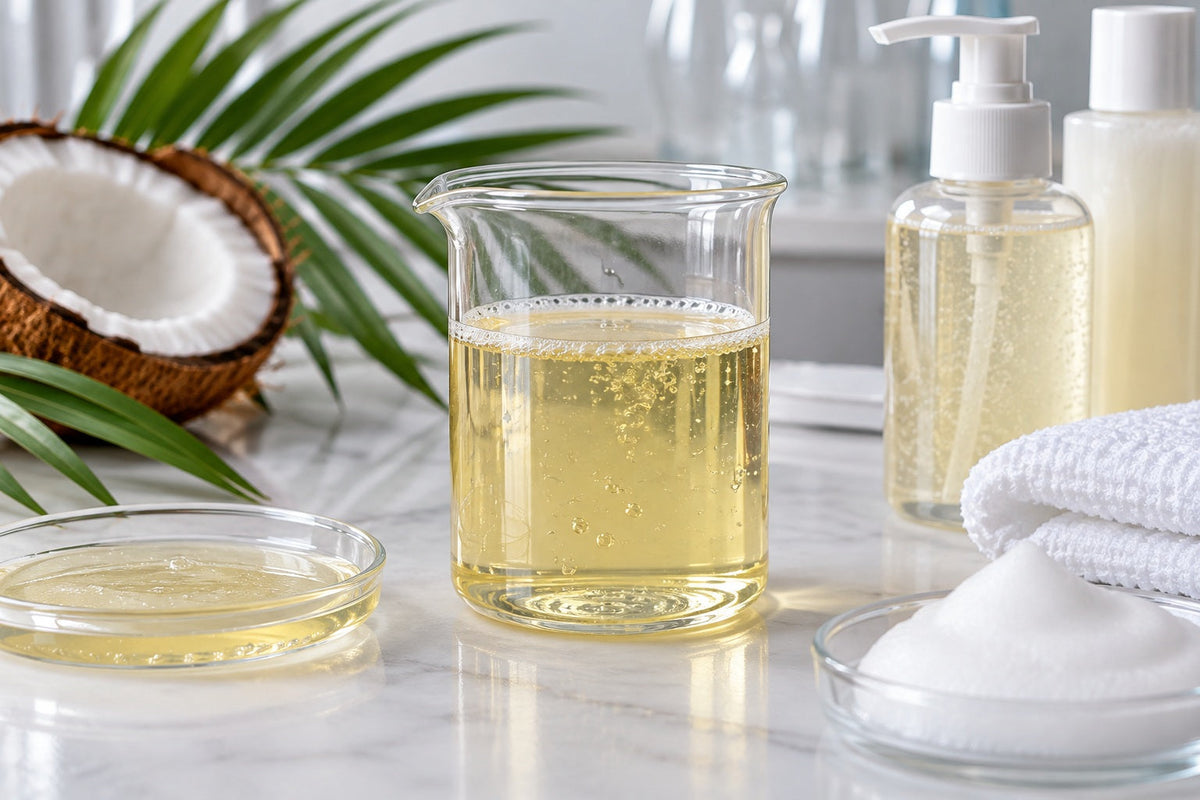
The pitch sounds clean: sulfate-free, big foam, squeaky rinse. The reviews sound different: stripped skin, a scalp clean on day one and irritated by week two, a face wash customers stop using. The founder is confused because the label told a gentle story. Sodium C14-16 olefin sulfonate never promised gentle. It promised strong — cleansing, flash foam, a thorough rinse — and a formula that spends that strength on the wrong job will feel harsh whatever the bottle says.
Sodium C14-16 olefin sulfonate in cosmetics is a powerful anionic cleanser — and power is not a flaw when the job calls for it. Body washes that have to cut through sunscreen and sweat, and shampoos that have to lift real buildup, are exactly its territory. The failure is a positioning failure: choosing a strong cleanser for a gentle daily job, then marketing the absence of sulfates as if it were the presence of mildness.
What sodium C14-16 olefin sulfonate actually is
On a cosmetic label, it appears as Sodium C14-16 Olefin Sulfonate. It is an alpha-olefin sulfonate: a synthetic anionic surfactant made by sulfonating C14-16 alpha-olefins and neutralising the result with sodium hydroxide. The C14-16 cut is the common personal-care grade: it balances solubility, detergency, and stable, generous foam.
The sulfate question deserves a straight answer. This ingredient is a sulfonate, not a sulfate. In a sulfate surfactant, the charged group hangs off the chain through an oxygen bridge — an ester bond that can hydrolyse, especially in acidic conditions. In a sulfonate, the sulfur bonds directly to carbon, which is chemically sturdier: it keeps performing across a wider pH range and does not break down the same way. So a product built on it can honestly be labelled sulfate-free. What that label does not say is anything about how strong the cleansing is.
The safety reviews match that framing: the Cosmetic Ingredient Review panel concluded sodium alpha-olefin sulfonates are safe in rinse-off products and up to 2% in leave-on products, with strict sultone impurity limits cosmetic-grade material is processed to meet.
Sodium C14-16 olefin sulfonate in cleansers: the decisions that decide clean versus stripped
Match the strength to the soil, not the marketing
Cleansing strength should be briefed against what has to come off. Sunscreen, sebum, sweat, and styling buildup are real soil; a mild system that leaves them behind earns its own bad reviews. Daily face cleansing for dry or sensitive skin is the opposite brief: light soil, all-day barrier. Sodium C14-16 olefin sulfonate earns its place in the first brief and is usually the wrong lead for the second. Write the soil and use frequency down first, and let that page — not the sulfate-free headline — make the decision.
A strong lead needs mildness partners, not a bigger dose
Used as a lead cleanser, this ingredient is normally blended: amphoteric and nonionic co-surfactants to soften the feel and enrich the foam, conditioning components, and a total surfactant load set for the job, not for maximum lather. The blend is the product. The same headline ingredient at the same level can feel thorough in one system and punishing in another, because foam, rinse feel, and after-feel belong to the whole system and its pH. Judge the finished wash on skin after real use — not the flash foam in the beaker on day one, this ingredient's most misleading talent.
Hard water and pH range are real advantages — spend them honestly
Its genuine strengths are two. It keeps cleansing and foaming in hard water, where some cleansers fade, and its sulfonate bond stays stable across pH ranges that would trouble sulfate esters. For a body wash or shampoo sold nationally, into water the founder does not control, that reliability is worth having — sold as what it is: dependable, thorough cleansing. The moment the copy converts sulfate-free into a gentleness promise the formula never made, the returns and the one-star reviews are already scheduled.

Where sodium C14-16 olefin sulfonate earns its place
- Body washes and shower gels — for real soil: sunscreen, sweat, and sebum, rinsed clean with generous foam.
- Shampoos, including clarifying formats — to lift oil and product buildup, blended for foam quality and after-feel.
- Sulfate-free rinse-off cleansers — where genuine strength is needed without a sulfate surfactant, and claims stay honest about it.
Stability, structure, and packaging are not footnotes
A strong cleanser still has to be stable. Test viscosity, clarity, foam, and scent in the real bottle after heat exposure, and check the pack delivers the intended dose at the finished viscosity. Because the ingredient is pH-stable, pH drift in the finished product is a system problem to investigate — not the lead surfactant's fault. Approve the scented, finished, packaged version — the only one a customer meets.
What to decide before you brief a run
Decide the soil first — what has to come off, how often, from whose skin or hair. Decide the system second: lead level, mildness partners, total load. Decide the claims third, in writing: sulfate-free if true, and nothing about gentleness the wear test has not earned. Test last and longest — a week of real use beats a beaker of foam.
Keep reading
- Body Wash: the everyday product customers judge without mercy
- Cosmetic Ingredient Lists: how to read and write yours before you print
How we approach it
At Simplicity Filling Systems, a sodium C14-16 olefin sulfonate project starts with the soil, the strength, and the claim on one page — in that order — then checks cleansing, after-feel, and a week of real use in the real pack before any label is printed. As a full turnkey partner, start to sold, we carry ingredient sourcing, manufacturing, bottling and packaging, fulfillment, and website and marketing support — across perfumes, body washes, creams, sugar scrubs, body oils, massage oils, beach body oil, deodorant, body butter, beard oil, and hair oil. Small runs welcome, startups welcome, built to scale. Comparing quotes? Show us a comparable written quote — we'll match it or beat it.
Frequently asked questions
Is sodium C14-16 olefin sulfonate a sulfate? No. It is a sulfonate: the sulfur bonds directly to carbon, not through a sulfate's oxygen ester bridge, which makes it more pH-stable. Sulfate-free is a chemistry statement, not a mildness rating.
Is sodium C14-16 olefin sulfonate gentle? It is a strong cleanser, and strength is the point. In a well-blended rinse-off system at a level matched to the soil, it can feel comfortable. Marketed as inherently gentle, or used at high load in a daily face wash for dry skin, it will feel stripping — because job and ingredient were mismatched.
Where is sodium C14-16 olefin sulfonate best used? In rinse-off products with real soil to remove — body washes, shampoos including clarifying formats, and sulfate-free cleansers needing thorough cleansing and generous foam, even in hard water.
Is sodium C14-16 olefin sulfonate safe in cosmetics? The Cosmetic Ingredient Review panel concluded sodium alpha-olefin sulfonates are safe in rinse-off products, and in leave-on products up to 2%, with strict sultone impurity limits. Its established home is rinse-off use.
Why does my sulfate-free wash still leave skin tight? Because tightness tracks cleansing strength and total surfactant load, not the sulfate label. A strong sulfonate lead dosed for maximum foam, without mildness partners, will strip — the fix is the blend and the level.
The bottom line
Sodium C14-16 olefin sulfonate rewards founders who sell strength honestly: brief the soil, blend for feel, and let sulfate-free mean what it means and nothing more. Matched to the right job, it is a dependable foundation for a body wash or shampoo.
Planning a body wash or shampoo and want the cleansing strength, blend, and claims checked before the label is printed? Contact us and tell us about the product. We will give you a straight answer on the formula, the packaging, and the run that proves it.
Simplicity Filling Systems — private-label and contract manufacturing in Sunrise, FL. Small runs welcome, startups welcome, built to scale.
Ready for your number?
Run your specs through our Quote Builder for an instant online quote — or reach out for a custom quote.
More from News

PEG-150 Distearate: The Thickener Founders Add Cold, Dose by Hope — and Then Blame When the Wash Stays Thin
Sodium Cocoyl Isethionate: The Gentle Cleanser Founders Expect to Pour Like Water — and Then Blame When the Bar Turns Gritty
