
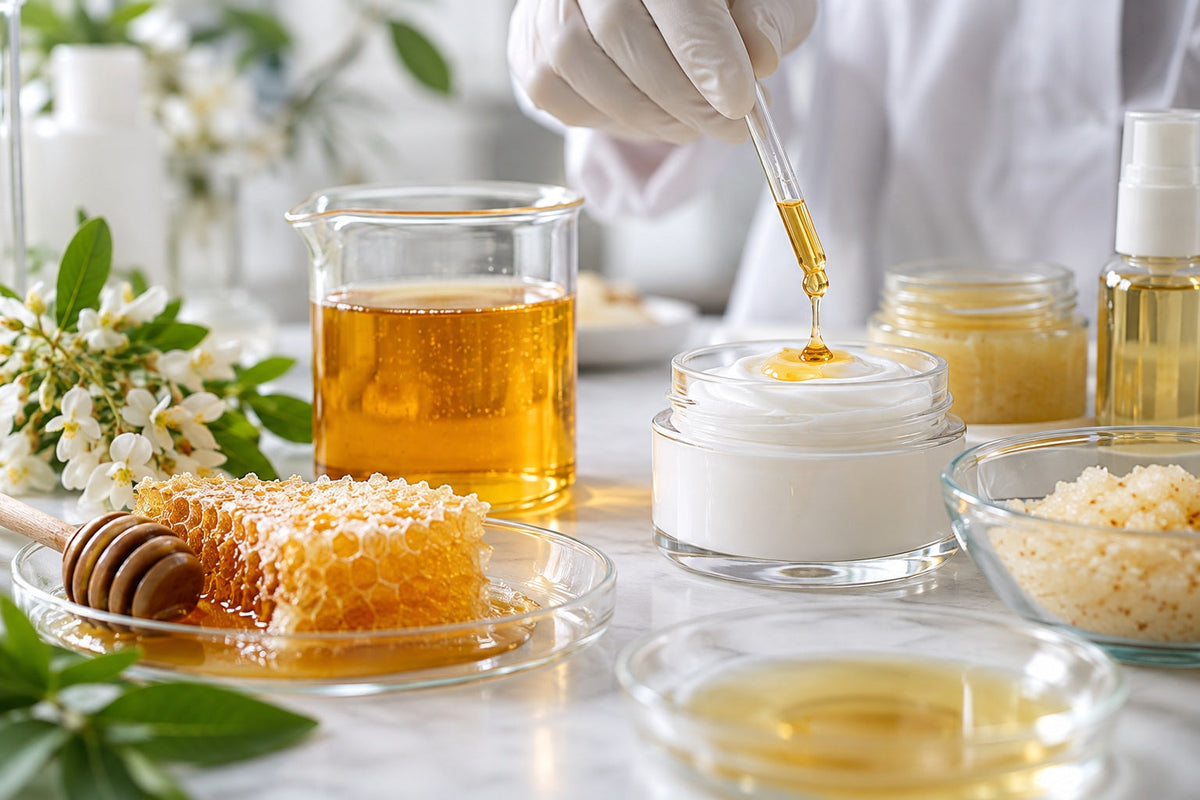
Every founder has had the same moment: a jar of honey on the counter, a product idea in the notebook, and the feeling that this one should be easy. Honey in cosmetic formulations sounds like the most natural brief in the world — an ingredient customers already trust from their own kitchen. That trust is exactly how honey launches go wrong. A founder stirs liquid honey into a formula as if it were a dry powder, forgets it brings its own water, pushes the level until the product turns sticky, or prints healing language a cosmetic cannot carry — and then wonders why the batch that smelled wonderful at the bench darkened in the jar.
Handled with its water load, heat limits, and honest claims in view, honey gives cleansers, masks, and washes the soft, comfortable experience that makes customers finish the jar.
What honey actually is
On a cosmetic label, honey appears as Honey or Mel. It is mostly sugars and water — roughly four-fifths sugars with a meaningful water fraction — which means every spoonful is also a water-phase decision, not just a story ingredient. It is water-soluble, so it belongs in the water phase of cleansers, masks, washes, and emulsions. It does not dissolve into a pure oil, so an anhydrous body oil is not a honey product.
The forms are not silent swaps. Liquid honey brings water, colour, and scent that vary with the floral source. Honey powder is a dried form that changes the water math and the label. Honey extract is a diluted preparation with its own specification. Specify the form, verify the material, and label from that specification.
Honey in cosmetic formulations: what it actually does
It is a humectant — it builds the soft, hydrated feel customers notice
The honest cosmetic story for honey is feel and appearance: skin that feels softer, smoother, and more comfortable after use, and looks less dry and tight. As a sugar-rich humectant it attracts and holds water at the skin's surface within the product experience. That is a cosmetic claim, and it is a good one when the finished product actually delivers it.
It is not an antibacterial treatment, a healer, or a preservative
This is where honey copy most often leaves the cosmetic lane. Honey's reputation from the kitchen and from medical contexts does not transfer to a cosmetic label. A cosmetic cannot claim to kill bacteria on skin, heal wounds, or repair damaged skin — those are drug claims, and borrowing them trades a dependable ingredient for a label a retailer can reject. The same discipline runs the other way: honey preserves nothing. A honey cleanser or mask needs a dedicated preservative system and preservative efficacy testing, and honey's own water and sugars raise that burden rather than lowering it.
More honey is not more glow — past a point, it is stickiness and drift
Honey follows the same rule as every humectant in this series: a level with a reason. Pushed too high, it turns tacky and slow to rinse. Its colour and scent move with source — one floral honey is pale and mild, another dark and assertive — so a level chosen from one supplier's jar can change the product when the source changes. Heat deserves the same respect: holding honey at high temperatures can darken colour and shift scent. Follow the supplier's addition stage, and put it in the batch record.
One positioning decision founders miss: honey is not vegan
Honey is an animal-derived ingredient. A product containing it cannot honestly carry a vegan positioning, no matter how plant-forward the rest of the formula reads. Decide that positioning before the label is designed, not after the first customer asks.

Where honey earns its place
- Foaming face washes and body washes — a comfortable, soft after-feel, balanced so the rinse still feels clean.
- Rinse-off face masks — the format where honey's texture and story are judged most directly, with preservation designed for a water-rich base.
- Creams — in the water phase of an emulsion, filled and packaged through our production partners with the same stability and preservation discipline.
Stability, preservation, and packaging are not footnotes
A honey product needs stability testing for texture, colour, scent, and pH in its real packaging. It needs preservative efficacy testing on the finished system — honey included — not the base alone. Packaging matters too: a wide-mouth jar invites water and fingers into a humectant-rich mask in a way a tube or pump does not, so choose the pack for the formula, not only for the photograph.
What to decide before you brief a run
Decide the form first — liquid honey, powder, or extract — and the water math it brings. Decide the level second, from the feel you want repeated, and test tack and rinse in the finished product. Decide vegan positioning, preservation, stability, and packaging third, as one system. Write the claims last, in feel and appearance language, with no antibacterial or healing promises borrowed from honey's reputation.
Keep reading
- Glycerin in cosmetics: the humectant level that helps instead of turning sticky
- Aloe vera in cosmetics: juice, gel and powder forms for cleansers and washes
How we approach it
At Simplicity Filling Systems, a honey project starts with the form, the level, and the water load side by side, then checks tack, preservation, and claims before any label is printed. As a full turnkey partner, start to sold, we carry ingredient sourcing, manufacturing, bottling and packaging, fulfillment, and website and marketing support — across perfumes, body washes, sugar scrubs, body oils, massage oils, beach body oil, deodorant, beard oil, and hair oil, with creams filled and packaged through our production partners. Small runs welcome, startups welcome, built to scale. Comparing quotes? Show us a comparable written quote — we'll match it or beat it.
Frequently asked questions
Is honey a preservative in cosmetics? No. Honey is a humectant, not a preservative system. A honey cleanser or mask still needs dedicated preservation and preservative efficacy testing — and honey's own water and sugars make that testing more important, not less.
Can a honey product be labelled vegan? No. Honey is animal-derived, so a product containing it cannot honestly carry a vegan claim. Decide the positioning before the label is designed.
Can honey heal skin or kill bacteria as a cosmetic claim? No. Those are drug claims. Cosmetic language covers feel and appearance: skin that feels softer, smoother, and more comfortable, and looks less dry after use.
Why does my honey product feel sticky? The level is the first suspect, followed by the total humectant load around it. Reduce toward a level the format can carry and re-test in real use, including the rinse.
Liquid honey, honey powder, or honey extract — does it matter? Yes. The forms differ in water load, colour, scent, and label specification. Specify the form, verify the material, and do not swap forms silently between sample and run.
The bottom line
Honey rewards founders who treat a familiar ingredient as a design task: the right form, a level the format supports, the water load counted honestly, and claims that stay with feel and appearance. That is how a kitchen staple becomes a product customers finish — instead of a sticky jar with a healing claim it was never allowed to make.
Planning a honey cleanser, mask, or wash and want the form, level, and preservation checked before the label is printed? Contact us and tell us about the product. We will give you a straight answer on the formula, the packaging, and the run that proves it.
Simplicity Filling Systems — private-label and contract manufacturing in Sunrise, FL. Small runs welcome, startups welcome, built to scale.
Ready for your number?
Run your specs through our Quote Builder for an instant online quote — or reach out for a custom quote.
More from News

PEG-150 Distearate: The Thickener Founders Add Cold, Dose by Hope — and Then Blame When the Wash Stays Thin
Sodium Cocoyl Isethionate: The Gentle Cleanser Founders Expect to Pour Like Water — and Then Blame When the Bar Turns Gritty
