
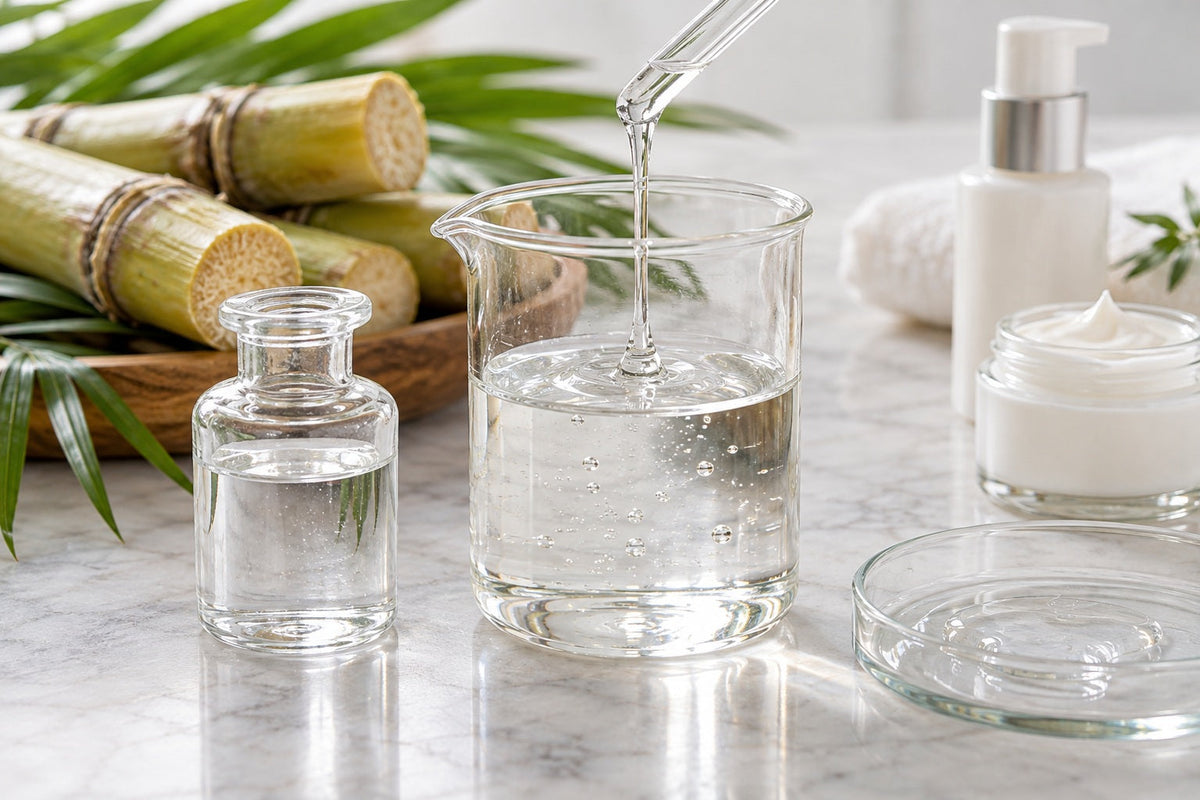
Glycerin is in almost every serum, wash, and cream a founder has ever loved, which is exactly why so many launches get it wrong. A founder reads that glycerin in cosmetics draws in moisture, doubles the level hoping for double the benefit, and ships a serum that feels like syrup, a face wash that will not rinse clean, and reviews that say "sticky" more often than they say anything else. Glycerin is not weak and it is not magic. It is a reliable humectant with a clear comfort zone — and outside that zone, it punishes the product instead of helping it.
Built at a level the formula can carry, glycerin gives water-based products the soft, hydrated feel customers expect on first use and on the fiftieth. That repeat feel, not a headline percentage, is what earns the second order.
What glycerin actually is
Glycerin, also called glycerol, appears on a cosmetic label simply as Glycerin. It is a clear, viscous, water-soluble liquid that mixes readily into the water phase of serums, cleansers, body washes, and the water phase of emulsions. It does not belong in a pure oil product, where it will not incorporate as a true solution and will separate or bead instead of performing.
It is supplied in grades and from different feedstocks, so specify cosmetic-appropriate material, verify what you receive, and write the label from that specification. The ingredient name is simple. The decisions that decide whether it helps or hurts — level, partners, and total water-phase design — are not.
Glycerin in cosmetics: what it actually does
It is a humectant — it holds water in the formula's feel
The honest cosmetic story for glycerin is hydration feel and appearance: skin that feels softer, smoother, and more comfortable after use, and a complexion that looks less dry and tight. As a humectant it attracts and holds water at the skin's surface within the product experience. That is a cosmetic claim. Glycerin in a cosmetic does not treat eczema, repair a medical skin condition, or heal damaged skin — and copy that borrows that language trades a dependable ingredient for a compliance problem.
More glycerin is not more benefit — past a point, it is tack
This is the lesson founders learn from reviews if they do not learn it at the bench. At moderate, purposeful levels glycerin feels smooth and cushioning. Pushed too high, it turns tacky and slow to absorb, drags on application, and can leave a residue customers wipe off — taking your other ingredients with it. In rinse-off products, excess glycerin can leave a slippery after-feel that reads as "did not rinse clean." Choose the level from the experience you want repeated daily. If a competitor prints a higher number, let them own the sticky reviews that come with it.
It supports the water phase, but it preserves nothing
Glycerin contributes to how a water phase feels and behaves, and at meaningful levels it can influence a formula's water activity — but it is not a preservative system. A glycerin-rich serum or wash is still a water-containing product that needs dedicated preservation and preservative efficacy testing. Founders who treat a humectant as protection end up with the same failure as founders who use no plan at all, just later and with more confidence than the formula deserved.

Where glycerin earns its place
- Water-based face serums — a measured humectant level for a soft, hydrated finish that does not pill or drag.
- Foaming face washes and body washes — a comfortable after-feel, balanced so the rinse still feels clean.
- Creams and body butters — in the water phase of an emulsion, for a smoother application and comfortable wear, filled and packaged with the same stability discipline.
- Sugar scrubs with a water-containing base — only where the base design actually supports it, never added on assumption.
Stability, texture, and packaging are part of the decision
Glycerin is comparatively stable, which tempts founders to skip the testing around it. Do not. The finished product still needs stability testing for texture, colour, scent, and pH in its real packaging, because glycerin interacts with thickeners, surfactants, and actives around it. A wash that thickened beautifully in a beaker can thin or cloud after fragrance and glycerin levels are finalised together. Test the finished system, not the ingredient in isolation. Packaging matters too: a wide-mouth jar invites water and contamination into a humectant-rich formula in a way a pump or tube does not, so choose the pack for the formula, not only for the photograph.
What to decide before you brief a run
Decide the product's job first — the hydrated, comfortable feel you want, in honest cosmetic language. Decide the glycerin level second, from that experience, and check tack and rinse against a real sample used the way a customer will use it. Decide preservation, thickening, and the rest of the water phase third, as one system. Write the claims last, from feel and appearance, with no treatment language borrowed from glycerin's reputation.
Keep reading
- Aloe vera in cosmetics: juice, gel and powder forms for cleansers and washes
- Niacinamide in cosmetics: choosing a vitamin B3 level with a reason
How we approach it
At Simplicity Filling Systems, a glycerin project starts with the level and the feel side by side, then checks tack, rinse, preservation, and claims before any label is printed. As a full turnkey partner, start to sold, we carry ingredient sourcing, manufacturing, bottling and packaging, fulfillment, and website and marketing support — across perfumes, body washes, sugar scrubs, body oils, massage oils, beach body oil, deodorant, beard oil, and hair oil, with creams filled and packaged through our production partners. Small runs welcome, startups welcome, built to scale. Comparing quotes? Show us a comparable written quote — we'll match it or beat it.
Frequently asked questions
Is glycerin the same as glycerol? Yes, in cosmetic sourcing glycerin and glycerol refer to the same ingredient, labelled as Glycerin. Specify cosmetic-appropriate material and verify what you receive.
How much glycerin should my product contain? A level set by the feel you want customers to repeat. Moderate levels usually give a smooth, hydrated feel; pushing far higher commonly adds tackiness and residue without improving the honest cosmetic story.
Can glycerin treat dry skin conditions or eczema? No. Those are drug claims. Cosmetic language covers feel and appearance: skin that feels softer, smoother, and more comfortable, and looks less dry after use.
Does glycerin preserve my product? No. Glycerin is a humectant, not a preservative system. Water-containing products still need dedicated preservation and preservative efficacy testing.
Why does my glycerin serum feel sticky? The level is the first suspect, followed by the total humectant load and the thickener system around it. Reduce toward a level the formula can carry and re-test the finished product in real use.
The bottom line
Glycerin rewards founders who respect its comfort zone: a purposeful level, a water phase designed as a system, real preservation, and claims that stay with feel and appearance. That is a quieter brief than doubling the percentage — and a product customers actually finish and rebuy.
Planning a glycerin serum, wash, or cream and want the level, feel, and claims checked before the label is printed? Contact us and tell us about the product. We will give you a straight answer on the formula, the packaging, and the run that proves it.
Simplicity Filling Systems — private-label and contract manufacturing in Sunrise, FL. Small runs welcome, startups welcome, built to scale.
Ready for your number?
Run your specs through our Quote Builder for an instant online quote — or reach out for a custom quote.
More from News

PEG-150 Distearate: The Thickener Founders Add Cold, Dose by Hope — and Then Blame When the Wash Stays Thin
Sodium Cocoyl Isethionate: The Gentle Cleanser Founders Expect to Pour Like Water — and Then Blame When the Bar Turns Gritty
