
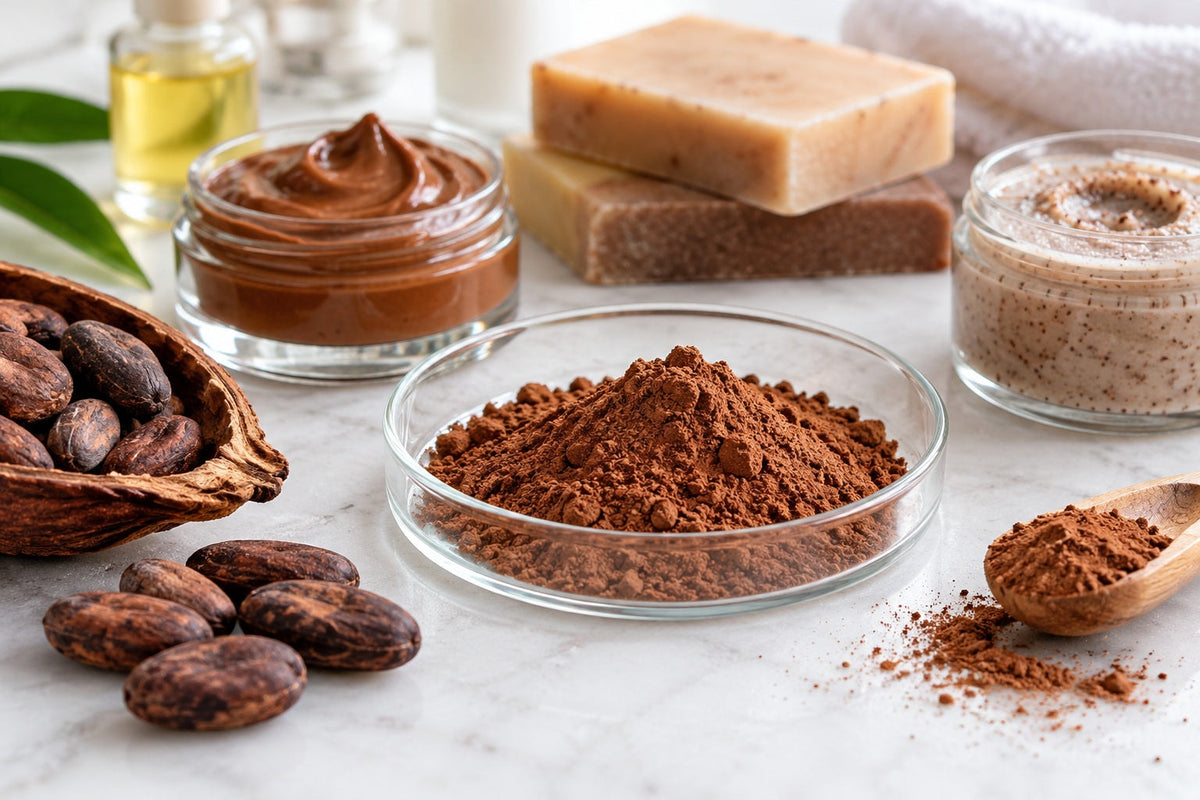
The confusion starts with the name. A founder falls for a chocolate scrub, orders "cocoa," and builds the brief around the rich, structural ingredient they have read about — when the powder in the bag is a completely different material from the butter in the block. Cocoa powder in cosmetic formulations is the dry, defatted solid left after cocoa butter is pressed out: it brings colour, scent, and a fine, water-hungry powder phase, and none of the structure or skin feel of the butter it shares a name with. Launches built on that confusion separate, stain, smell flat within weeks, or carry treatment claims the powder was never going to support.
Handled as its own ingredient — specified, dispersed properly, and claimed honestly — cocoa powder gives scrubs, masks, and washes a gourmand story customers can smell before the jar is open.
What cocoa powder actually is
On a cosmetic label, cocoa powder appears as Theobroma Cacao (Cocoa) Seed Powder or the corresponding name for the material you use. It is the pressed, ground solid of the cocoa bean with most of the cocoa butter removed. That one fact drives everything else: it does not melt into a formula like a butter, does not hold a balm together, and does not deliver the emollient feel founders associate with the word "cocoa."
The second specification founders miss is the process. Natural cocoa powder is lighter and more acidic in character. Dutch-processed cocoa has been alkalised, which darkens the colour, mellows the scent, and shifts the pH it brings to your system. The two are not a silent swap. Specify the type, verify the material, and formulate from that specification.
Cocoa powder in cosmetic formulations: what it actually does
It is colour and story first — a visible, scented powder phase
The honest cosmetic story for cocoa powder is sensory: a deep colour customers read as rich before they touch the product, a warm chocolate scent in dry and rinse-off formats, and skin that feels softer after a scrub or mask is rinsed away. In a scrub it sits alongside the true exfoliant particles as part of the powder phase. In a dry mask it is a headline ingredient the customer activates with water at home. Those are real, sellable benefits — when the product delivers them and the claims stay with feel and appearance.
It is not an antioxidant treatment, and the scent will not perfume the product alone
Cocoa's food reputation follows it into cosmetics, and founders borrow claims it cannot carry. A cosmetic scrub or mask cannot promise to reverse ageing, repair skin, or deliver a therapeutic antioxidant effect — those are drug claims, and they trade a product customers enjoy for a label a retailer can reject. Set the same expectation for scent: cocoa powder smells warm in the jar, but it is not a fragrance system. In a strongly scented line, the chocolate story needs a fragrance decision made alongside the powder — not the assumption that the powder will perfume the product by itself at month six.
It stains, it settles, and it drinks water — design for all three
Cocoa powder is a dark, fine powder, and it behaves like one. It can tint skin during use, colour a tub or washcloth, and stain light fabrics — a directions problem as much as a formula problem. In a liquid system it does not dissolve; it suspends, and an undesigned suspension will settle or streak. In a water-based mask or wash it brings a full preservation burden: a dedicated preservative system, efficacy testing, and pH checked with the powder in the system — especially with Dutch-processed material, whose alkalised character moves the number founders measured without it.

Where cocoa powder earns its place
- Dry face and body masks — the customer activates the powder at home, so the product stays dry until use.
- Sugar scrubs and emulsified body scrubs — as the colour and story layer alongside specified exfoliant particles, with a rinse tested in a real shower.
- Rinse-off cleansers and body washes — where suspension, pH, and preservation are designed for a powder that does not dissolve.
Stability, dispersion, and packaging are not footnotes
A cocoa powder product needs stability testing for colour, scent, texture, and — in water-based systems — pH in its real packaging. Dispersion belongs in the batch record: how the powder is wetted and incorporated decides whether the run is even or streaked, and a bench method can fail at batch scale if left to habit. Dry masks and scrubs need packaging that keeps moisture out between uses, because a powder that picks up water cakes and darkens.
What to decide before you brief a run
Decide the material first — natural or Dutch-processed, specified and verified — and be certain the brief is not quietly asking for cocoa butter instead. Decide the format second: dry, oil-based, or water-based, with suspension, preservation, and pH designed for that system. Decide use directions third, written for a real bathroom. Write the claims last, with no treatment promises borrowed from cocoa's food reputation.
Keep reading
- Cocoa Butter: the hard butter behind the snap — and the bloom that follows careless cooling
- Emulsified Body Scrubs: the scrub that rinses like a lotion, not an oil slick
How we approach it
At Simplicity Filling Systems, a cocoa powder project starts with the specification, the process type, and the format side by side, then checks dispersion, preservation, and claims before any label is printed. As a full turnkey partner, start to sold, we carry ingredient sourcing, manufacturing, bottling and packaging, fulfillment, and website and marketing support — across perfumes, body washes, sugar scrubs, body oils, massage oils, beach body oil, deodorant, beard oil, and hair oil, with creams filled and packaged through our production partners. Small runs welcome, startups welcome, built to scale. Comparing quotes? Show us a comparable written quote — we'll match it or beat it.
Frequently asked questions
Is cocoa powder the same as cocoa butter? No. Cocoa powder is the dry, defatted solid; cocoa butter is the fat pressed out of it. The powder brings colour and scent. The butter brings structure and emollient feel. They are not interchangeable.
Natural or Dutch-processed cocoa powder — does it matter? Yes. Dutch processing darkens the colour, mellows the scent, and shifts the pH the powder brings to a water-based system. Specify the type and check the finished product's pH with the powder in it.
Can cocoa powder claim antioxidant or anti-ageing benefits? Not as treatment claims. Those are drug claims. Cosmetic language covers feel, appearance, and experience: skin that feels softer and smoother after use, in a product with a rich colour and scent.
Will a cocoa scrub or mask stain? It can tint skin during use and colour tubs, washcloths, and light fabrics. Honest use directions and a rinse tested in a real shower handle most of it.
Does a cocoa powder product need a preservative? A dry product kept dry is a different case from a water-based mask or wash, which needs a dedicated preservative system and preservative efficacy testing.
The bottom line
Cocoa powder rewards founders who respect what it actually is: a specified, sensory powder phase — not a butter, not a fragrance, and not a treatment. Get the process type, format, and claims right, and the chocolate story customers fell for at the jar is still true at the rinse.
Planning a cocoa scrub, mask, or wash and want the specification, format, and claims checked before the label is printed? Contact us and tell us about the product. We will give you a straight answer on the formula, the packaging, and the run that proves it.
Simplicity Filling Systems — private-label and contract manufacturing in Sunrise, FL. Small runs welcome, startups welcome, built to scale.
Ready for your number?
Run your specs through our Quote Builder for an instant online quote — or reach out for a custom quote.
More from News

PEG-150 Distearate: The Thickener Founders Add Cold, Dose by Hope — and Then Blame When the Wash Stays Thin
Sodium Cocoyl Isethionate: The Gentle Cleanser Founders Expect to Pour Like Water — and Then Blame When the Bar Turns Gritty
