
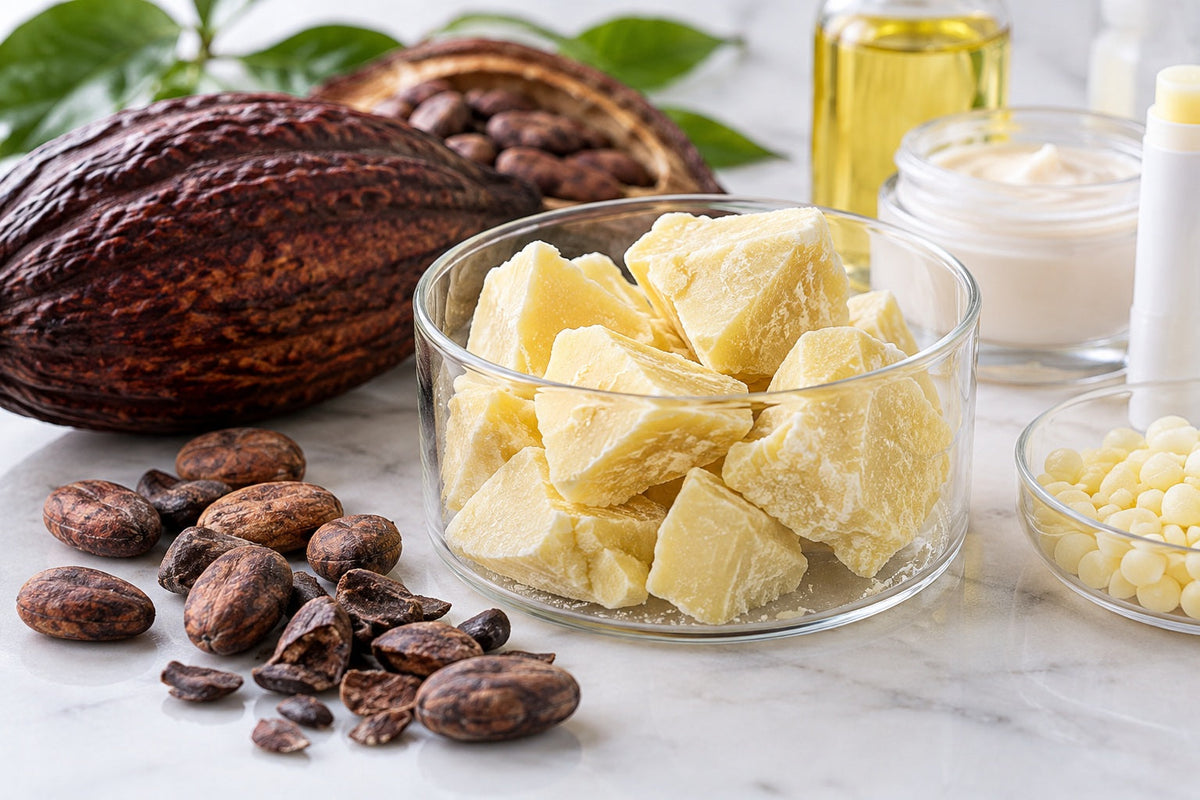
Snap a piece of good chocolate and you already know cocoa butter's signature: it is the hardest of the common cosmetic butters, brittle at room temperature, and it melts right around body temperature into a rich, dry-feeling oil. That snap-and-melt profile makes cocoa butter irreplaceable in balms and bars. It also makes it the butter most likely to punish a careless production run — with surface bloom, cracking, and a product that feels different in month three than it did in week one. Cocoa butter is not difficult. It is precise.
What cocoa butter actually is
Cocoa butter is the fat pressed from cacao beans, listed as Theobroma Cacao (Cocoa) Seed Butter. Its fatty acid profile — heavy in stearic and palmitic acids with a substantial oleic share — gives it a uniquely uniform crystal structure for a natural fat. That uniformity is the whole story: it is firm and brittle when cool, holds sharp shapes in sticks and bars, and melts cleanly on skin contact instead of lingering greasy. Formulators reach for cocoa butter when a product needs structure that disappears on use.
The grades founders confuse
Natural (prime pressed) cocoa butter
Natural cocoa butter keeps its pale gold color and its unmistakable chocolate scent. In a product where cocoa is the story — a cocoa body butter, a chocolate-scented balm — that scent is free fragrance and free marketing. In a product scented with anything delicate, it will compete, and against light florals it usually wins whether you wanted it to or not.
Deodorized cocoa butter
Deodorized cocoa butter has the scent (and some color) removed, keeping the same melt and structure in a neutral base. This is the grade for fragranced balms, sticks, and butters where cocoa's physics are wanted but its perfume is not. As always: the purchase order, the formula, and the label must all name the same grade. "Cocoa butter" on an order, unqualified, is how a vanilla balm ends up smelling like a candy bar.

Bloom: the defect that is really a crystal lesson
What bloom looks like
Weeks or months after production, a cocoa-butter product can develop a pale, dusty, or streaky surface — fat bloom. Customers read it as mold or staleness. It is neither: it is cocoa butter's crystals slowly reorganizing into a more stable form and migrating to the surface, the same phenomenon that whitens a chocolate bar stored through warm and cool cycles.
Why it happens, and how it is prevented
Cocoa butter is polymorphic — it can solidify into several crystal forms, and only the stable, well-tempered form gives the snap, gloss, and clean melt customers expect. Melt it too hot, cool it too slowly or unevenly, or store the finished product through repeated temperature swings, and the crystals set in unstable forms that later transform — blooming, softening, or cracking as they go. Prevention is pure process discipline: controlled melt temperatures that do not cook the butter, deliberate cooling and tempering profiles, and steady storage. It is the same lesson as shea's graininess, in a stricter teacher — butters remember how they were cooled.
How cocoa butter behaves in a formula
Cocoa butter contributes hardness, shape retention, and a distinctive dry-rich after-feel — less greasy than its richness suggests, because it melts and spreads thin. In lip and body balms it provides the stick structure that softer butters cannot. In body butters it firms up blends that shea alone leaves soft, especially in warm climates. In lotion bars and massage bars it is often the backbone. Its limits follow its strengths: too high a share makes products brittle, prone to cracking and drag on application; it needs softer partners — liquid oils, shea, mango butter — to balance snap with glide. And a cocoa-rich product is a warm-weather shipping product only with packaging and insulation decisions made on purpose.
Where cocoa butter earns its place
- Lip balms and lip products — structure, protection-feel, and a clean melt in a tiny format.
- Lotion and massage bars — the backbone that lets a solid bar hold its shape until skin warmth takes it.
- Body butters — as the firming partner that keeps a shea-based butter standing up in summer.
- Balms and sticks — deodorant and solid formats where shape retention is the product.
- Soap — a classic hardness contributor in bar soap, in balanced percentages.
Claims and sourcing discipline
Buy documented material of a stated grade — natural or deodorized — and keep finished goods in steady temperatures; cocoa butter products are the most storage-sensitive items in a butter line-up, and a hot warehouse undoes good tempering.
Claims stay in the cosmetic lane: rich, conditioning, smooth-feeling, a protected, comfortable feel. Cocoa scent is a sensory pleasure, not a therapy claim, and cocoa butter does not prevent stretch marks or heal skin — those claims do not belong on the jar. The honest pitch is texture: nothing else melts quite like it.
Keep reading
- Shea butter: the workhorse butter — and the graininess problem nobody warns you about
- Coconut oil: the familiar oil customers love — and the melting traps founders miss
How we approach it
At Simplicity Filling Systems, cocoa butter work starts with grade and temper: the right butter for the scent plan, melt and cooling profiles that set the stable crystal form, and packaging matched to a product that will meet summer somewhere between our dock and your customer. As a full turnkey partner, start to sold, we carry ingredient sourcing, manufacturing, bottling and packaging, fulfillment, and website and marketing support — across body butter, deodorant, sugar scrubs, body oils, creams, massage oils, body washes, perfumes, and hair oil. Small runs welcome, startups welcome, built to scale. Comparing quotes? Show us a comparable written quote — we'll match it or beat it.
Frequently asked questions
What is the white film on my cocoa butter product? Almost certainly fat bloom — cocoa butter crystals reorganizing on the surface after temperature swings or imperfect tempering. It is cosmetic, not contamination, and the product performs the same, but it looks like a defect. Controlled tempering in production and steady storage are the preventions.
Why does my cocoa butter balm crack? Cocoa butter is naturally brittle. Too high a percentage without softer balancing oils or butters makes sticks and bars prone to cracking and drag. The fix is formula balance plus disciplined cooling, not more heat.
Natural or deodorized cocoa butter — which should I choose? Choose natural when cocoa's chocolate scent is part of your product's identity. Choose deodorized when you are adding your own fragrance or need a neutral base. The structure and melt are the same; the scent is the decision.
Does cocoa butter melt in summer? Its melt point sits near body temperature, so cocoa-rich products soften readily in heat. Structure, packaging, insulation decisions for summer shipping, and honest customer language are the standard defenses.
Is cocoa butter greasy? Less than its richness suggests. It melts on contact and spreads into a comparatively dry, smooth-feeling film — one of the reasons it anchors balms and bars that softer, greasier butters cannot hold.
The bottom line
Cocoa butter is the precision butter: unmatched snap, clean body-temperature melt, and zero forgiveness for sloppy cooling. Spec the grade, temper with discipline, store it steady, and it gives balms, bars, and butters a structure no other natural butter can copy.
Thinking about a balm, lotion bar, or firm body butter built on cocoa butter? Contact us and tell us the product and the scent plan. We will give you a straight answer on the formula, the packaging, and the run that proves it.
Simplicity Filling Systems — private-label and contract manufacturing in Sunrise, FL. GMP facility, 18+ years. Small runs welcome, startups welcome, built to scale.
Ready for your number?
Run your specs through our Quote Builder for an instant online quote — or reach out for a custom quote.
More from News

PEG-150 Distearate: The Thickener Founders Add Cold, Dose by Hope — and Then Blame When the Wash Stays Thin
Sodium Cocoyl Isethionate: The Gentle Cleanser Founders Expect to Pour Like Water — and Then Blame When the Bar Turns Gritty
