
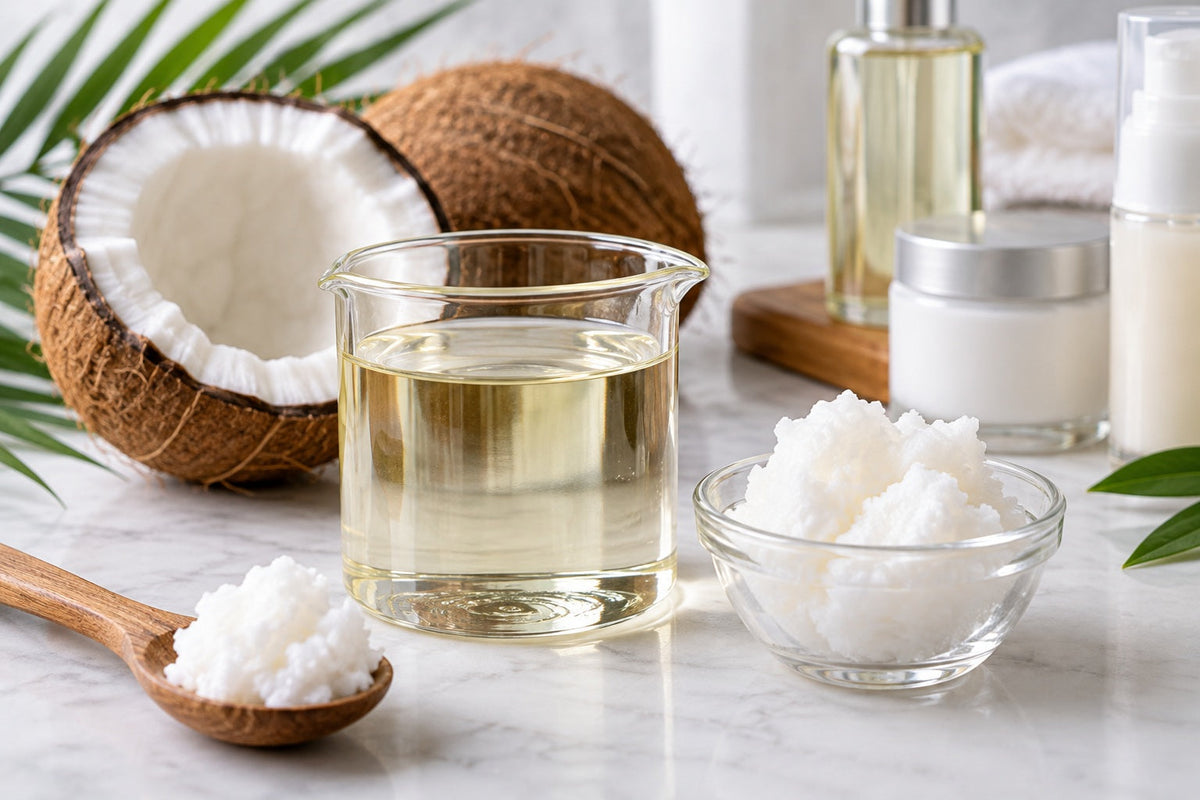
Every customer already knows coconut oil. That familiarity sells the first jar — and then summer arrives, the product that left your facility as a firm, white solid reaches a warm mailbox as a clear liquid, and the reviews ask why it "melted," "separated," or "changed." Coconut oil did exactly what coconut oil always does. The trap is not the ingredient. The trap is launching it without designing for its melting point, its feel, and the difference between whole coconut oil and its fractionated cousin.
Two ingredients founders confuse
Whole coconut oil
Whole coconut oil is obtained from coconut flesh and is rich in saturated fatty acids, notably lauric acid. Its defining behaviour is its melt: it is typically firm or solid when cool and liquid when warm, changing at roughly room temperature — around the mid-70s Fahrenheit. On an ingredient list it appears as Cocos Nucifera (Coconut) Oil. It has a characteristic coconut scent in its less-refined forms; refined grades are much quieter. Either way, the melt does not go away with refining.
Fractionated coconut oil
Fractionated coconut oil is a fraction of the whole oil — mainly the caprylic and capric triglycerides, covered in depth in our caprylic/capric triglyceride post. It stays liquid, feels much drier and lighter, and carries little to no coconut scent. It is a different ingredient with a different finish. A formula, label, or customer promise built for one will disappoint with the other, so name, buy, and document exactly which one you mean — every time, on every order.
How whole coconut oil behaves
The melt is a design requirement
A body butter, balm, scrub, or deodorant built on whole coconut oil will soften, slump, or liquefy in heat and firm up again in the cold. Re-solidifying can also change texture, including graininess in some butter systems. None of that means the product is spoiled — but a customer who was not prepared for it will read it as a defect. Design for it: build structure with butters and waxes appropriate to the formula, choose jars and closures that tolerate a soft product, fill and ship with warm weather in mind, and use honest label or insert language that a natural product may soften in heat and firm in cold.
A rich, occlusive-feeling finish
On skin, coconut oil feels rich and leaves a noticeable conditioning film. Many customers love exactly that in body products and scrubs. Others find it too much, particularly on the face. That is a fit question, not a verdict: position coconut-rich formulas where a rich finish is the promise — body, hands, hair ends, scrub — and think carefully before making it the lead oil in a facial product sold as lightweight.
Hair: the use customers ask for most
Coconut oil has a long history in hair routines, as a pre-wash treatment or a small amount through the lengths and ends. A little goes a long way; too much leaves hair coated and hard to wash out. Keep hair language in appearance and feel — looks shinier, feels smoother — and leave growth and repair claims out.

Where coconut oil earns its place
- Body butter and balms — blended with shea or cocoa butter and structuring ingredients so the finished product holds its form across real temperatures, not just in an air-conditioned lab.
- Sugar scrubs — a classic oil phase: it coats the sugar evenly, carries scent well, and leaves the conditioned after-feel scrub customers are buying. The melt still applies — a warm shower and a warm warehouse both count.
- Body oils — usually as part of a blend, where lighter carriers temper its richness and the coconut character is a feature of the scent and feel.
- Hair oil — in measured amounts or blended lighter, with clear use instructions so customers get shine without a coated finish.
- Deodorant and solid products — as part of a structured system where waxes and powders do the holding work coconut oil alone cannot do in summer.
- Soap and wash-off products — a traditional soapmaking oil where the finished, saponified product is a different thing from the raw oil on skin; formulate and label it as what it becomes.
A coconut product tested only in winter, only in the lab, or only as fractionated material will fail its first summer in the field. Test the season, not just the sample.
Claims and sourcing discipline
Buy the grade your product promises: refined cosmetic material for a quiet scent and consistent behaviour, or a less-refined grade when a true coconut scent is part of the product — documented either way, with batch and specification on file. Virgin on a label must mean virgin in the drum.
Keep claims in the cosmetic lane. Do not promise antibacterial treatment, sun protection, eczema relief, or any medical result. Coconut oil needs none of it. Its honest pitch is familiarity, scent, richness, and a conditioned feel customers have trusted in their routines for years — delivered in a product that behaves the way they expected when they open it in July.
How we approach it
At Simplicity Filling Systems, coconut oil is never a default pour: we confirm whole versus fractionated in writing, build structure for the melt, and test the finished product across the temperatures it will actually meet. As a full turnkey partner, start to sold, we carry ingredient sourcing, manufacturing, bottling and packaging, fulfilment, and website and marketing support — across body butter, sugar scrubs, body oils, hair oil, deodorant, creams, body washes, perfumes, and massage oils. Small runs welcome, startups welcome, built to scale. Comparing quotes? Show us a comparable written quote — we'll match it or beat it.
Frequently asked questions
Why did my coconut oil product melt? Whole coconut oil naturally changes from firm to liquid around the mid-70s Fahrenheit. Warm shipping, storage, or a hot bathroom will melt a coconut-rich product. Structure, packaging, and honest customer language are the fixes — not pretending it will not happen.
What is the difference between coconut oil and fractionated coconut oil? Whole coconut oil is rich in lauric acid, feels richer, may carry coconut scent, and solidifies when cool. Fractionated coconut oil is the lighter liquid fraction, stays liquid, feels drier, and has little scent. They are different ingredients and are not interchangeable without reformulating.
Is coconut oil good for face products? It depends on the product and the customer. Its rich film suits many body products, but it is a heavy lead for a facial oil sold as lightweight or universal. Many founders keep coconut in a supporting role on the face, or use other carriers there and save coconut for body, scrub, and hair.
Does coconut oil protect skin from the sun or treat skin conditions? No. Those are drug claims, not cosmetic ones, and they do not belong on a coconut oil product. Keep language to feel and appearance: rich, conditioning, soft- and smooth-feeling.
How should coconut oil products be stored? Sealed, out of prolonged heat where possible, with the understanding that softening in warmth and firming in cool conditions are normal for whole coconut oil. Tell customers that plainly and the behaviour reads as natural, not defective.
The bottom line
Coconut oil is a proven, beloved ingredient with one non-negotiable behaviour: it melts. Respect the melt in your structure, your packaging, and your customer language, be exact about whole versus fractionated, and the familiarity that sold the first jar will survive the first summer.
Thinking about a body butter, scrub, or body oil built on coconut? Contact us and tell us the product, whether you mean whole or fractionated, and where your customers will store it. We will give you a straight answer on the formula, the jar, and the run that proves it.
Simplicity Filling Systems — private-label and contract manufacturing in Sunrise, FL. GMP facility, 18+ years. Small runs welcome, startups welcome, built to scale.*
Ready for your number?
Run your specs through our Quote Builder for an instant online quote — or reach out for a custom quote.
More from News

PEG-150 Distearate: The Thickener Founders Add Cold, Dose by Hope — and Then Blame When the Wash Stays Thin
Sodium Cocoyl Isethionate: The Gentle Cleanser Founders Expect to Pour Like Water — and Then Blame When the Bar Turns Gritty
