
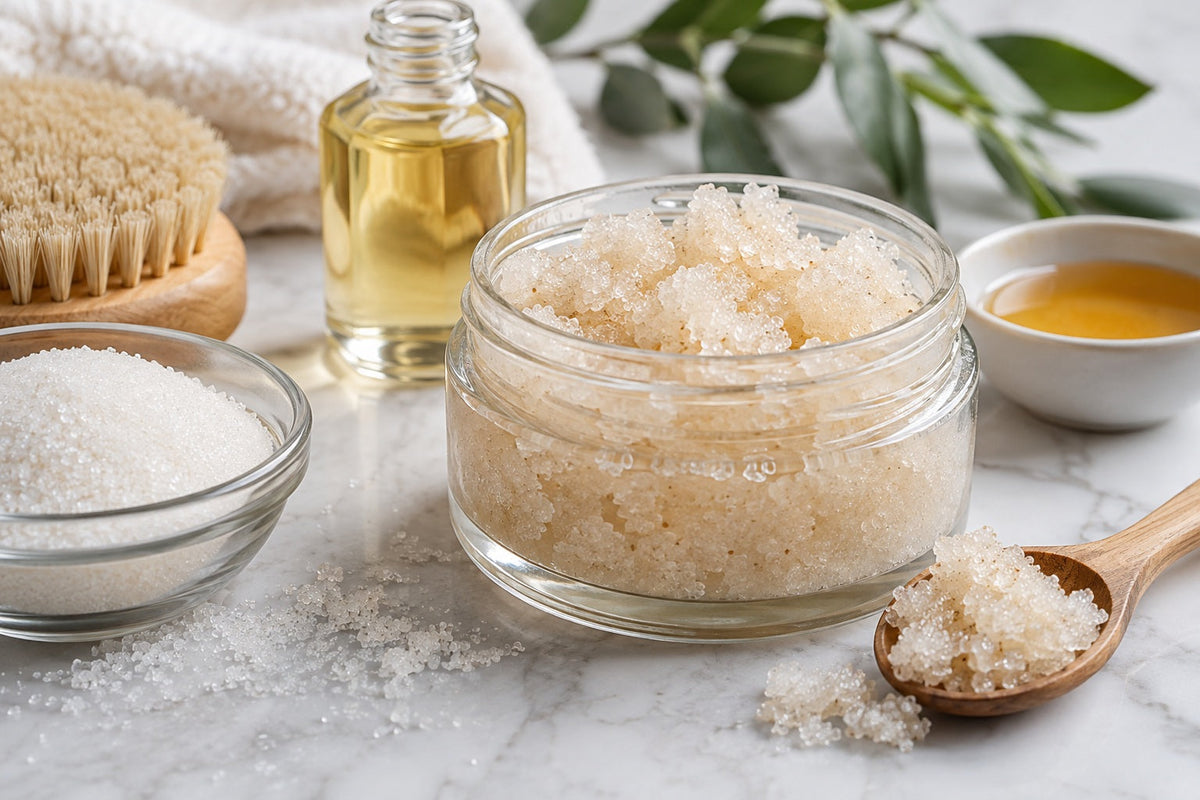
You have felt the review before you have read it. A customer buys a sugar scrub expecting a polish that melts away, uses it once, and writes that it scratched, dissolved before it did anything, or left skin raw. The founder blames the idea. The real problem is almost always the specification. Sugar as a cosmetic exfoliant is not one ingredient with one behaviour — crystal size, sugar type, and the base around it decide whether the same word on a label feels gentle or punishing.
Specified properly, sugar polishes, softens its edges in use, and rinses into a routine customers repeat. Specified loosely, it is a complaint waiting for its first shower.
What sugar actually is as an exfoliant
On a cosmetic label, sugar appears as Sucrose. That covers materials that behave differently in the jar: fine caster-style sugar, standard granulated sugar, coarser raw crystals, and brown sugar, which carries molasses and extra moisture. They are not interchangeable, and a brief that just says "sugar" has not specified the product at all.
Sugar exfoliates mechanically. The crystal does the work as the customer massages the product over skin. Unlike a hard, insoluble particle, sugar also dissolves in water as it is used — the edges round, the particle shrinks, and the polish eases off during the rinse. That dissolving behaviour is the whole appeal, and the whole risk.
Sugar as a cosmetic exfoliant: the decisions that decide the feel
Crystal size is the strength dial — not the percentage alone
Founders often try to make a scrub stronger by adding more sugar. The faster lever is crystal size. Fine crystals polish lightly and dissolve quickly. Standard granulated crystals give the classic body scrub feel most customers recognise. Coarse crystals last longer and polish harder, and they punish delicate skin if the directions invite hard scrubbing.
Percentage still matters — too little sugar feels greasy with no payoff, too much feels dry and crumbly — but size and percentage work together. Specify both, check the crystal lot to lot, and test on wet skin. A scrub approved dry on the back of a hand has not been tested.
Brown sugar is not just darker sugar — it brings water with it
Brown sugar feels softer in the hand, and founders reach for it for that story. What they miss is the molasses: it brings colour, scent, and moisture into the batch. That moisture changes texture, can soften crystals in storage, and moves a dry formula closer to a water-activity conversation the founder thought they had avoided. None of that makes brown sugar wrong. It makes it a different specification, with stability checked for the material you actually chose.
The base decides whether sugar helps or hurts
Sugar does not work alone. In a simple oil base, the crystals need enough structure to stay distributed instead of settling into a hard layer under oil. In an emulsified scrub, the base can suspend sugar more evenly and rinse cleaner, leaving skin conditioned rather than slick. In a wash-off cleanser, contact time is short and dissolution is fast, so the story has to be honest about how much polishing can happen in seconds.
Sugar also has a humectant reputation — it attracts water — but in a rinse-off scrub the headline job is mechanical polish and feel after rinsing. Do not let a secondary property carry the story while the crystal, base, and rinse go undesigned.
The glycolic acid myth: do not borrow a chemical claim for a physical scrub
Sugar is sometimes marketed with a chemical-exfoliant story because sugar cane is associated with glycolic acid. A jar of sucrose crystals is not a glycolic acid treatment. It will not deliver a controlled acid exfoliation or resurface skin in the chemical sense, and copy that promises that invites returns and retailer pushback. The honest claim is strong enough: skin that feels smoother, softer, and more polished after use — what the customer can verify in one shower.

Where sugar earns its place
- Oil-based sugar scrubs — the classic format, where crystal size, oil choice, and suspension decide whether the jar stays even.
- Emulsified body scrubs — for a cleaner rinse and a lotion-like after-feel, with preservation designed for the full system.
- Lip and targeted scrubs in small formats — where fine crystals, short use, and clear directions keep the polish appropriate to a small area.
Stability, storage, and packaging are not footnotes
Sugar wants water, and a bathroom gives it plenty of chances to find it. A wide-mouth jar dipped into with wet hands will soften crystals, change texture, and invite contamination. Packaging that limits water entry, directions to use dry hands or a scoop, and a preservative decision made for real in-use conditions protect the product. Stability testing should check crystal feel, separation, scent, and texture in the real pack — a scrub that cakes at month three will be judged as a quality failure, not an ingredient lesson.
What to decide before you brief a run
Decide the sugar first — type and a specified crystal range, not just "sucrose." Decide the base second: oil-based or emulsified, with suspension and preservation matched to that system. Decide the body area and directions third, written for real pressure on wet skin. Write the claims last, with no chemical-peel story borrowed for a physical exfoliant.
Keep reading
- Sugar Scrubs: the exfoliant customers judge by rinse and after-feel
- Emulsified Body Scrubs: the scrub that rinses like a lotion, not an oil slick
How we approach it
At Simplicity Filling Systems, a sugar exfoliant project starts with the crystal, the sugar type, and the base side by side, then checks suspension, rinse, and claims before any label is printed. As a full turnkey partner, start to sold, we carry ingredient sourcing, manufacturing, bottling and packaging, fulfillment, and website and marketing support — across perfumes, body washes, creams, sugar scrubs, body oils, massage oils, beach body oil, deodorant, body butter, beard oil, and hair oil. Small runs welcome, startups welcome, built to scale. Comparing quotes? Show us a comparable written quote — we'll match it or beat it.
Frequently asked questions
Is finer sugar always gentler? Generally, finer crystals polish more lightly and dissolve faster, but pressure, percentage, and the base matter too. Specify the crystal range and test the finished product on wet skin.
Is brown sugar better than white sugar in a scrub? Neither is automatically better. Brown sugar brings molasses, moisture, colour, and scent, which change stability and texture. It is a different specification, not an upgrade.
Does sugar exfoliate like glycolic acid? No. Sugar crystals exfoliate mechanically as they are massaged over skin and dissolve. That is not a controlled chemical acid treatment, and the copy should not claim it is.
Why did my sugar scrub separate into oil on top and a hard layer below? The base did not suspend the crystals for that crystal size and fill. Suspension, crystal range, and fill temperature belong in the batch design, not in a remix instruction on the label.
Does a sugar scrub need a preservative? A truly dry, oil-based scrub is a different case from an emulsified or water-containing scrub, which needs a dedicated preservative system and efficacy testing. In-use water from wet hands belongs in that decision too.
The bottom line
Sugar as a cosmetic exfoliant rewards founders who specify what others leave vague: the type, the crystal, the base, and a rinse tested in a real shower. Get those right, and the gentle polish on the label is the polish the customer feels.
Planning a sugar scrub and want the crystal, base, and claims checked before the label is printed? Contact us and tell us about the product. We will give you a straight answer on the formula, the packaging, and the run that proves it.
Simplicity Filling Systems — private-label and contract manufacturing in Sunrise, FL. Small runs welcome, startups welcome, built to scale.
Ready for your number?
Run your specs through our Quote Builder for an instant online quote — or reach out for a custom quote.
More from News

PEG-150 Distearate: The Thickener Founders Add Cold, Dose by Hope — and Then Blame When the Wash Stays Thin
Sodium Cocoyl Isethionate: The Gentle Cleanser Founders Expect to Pour Like Water — and Then Blame When the Bar Turns Gritty
