
You find an oil with a real story, a colour customers can see, and a devoted following — and then the first batch smells stronger than the sample, the colour varies, and marketing wants to promise more than any cosmetic oil should. That is rosehip oil. Handled well, it is the character ingredient that makes a face oil distinctive instead of generic. Handled carelessly, it becomes an oxidation problem in an expensive bottle with claims you cannot support. The difference is blending discipline, packaging discipline, and honest language.
What rosehip oil is
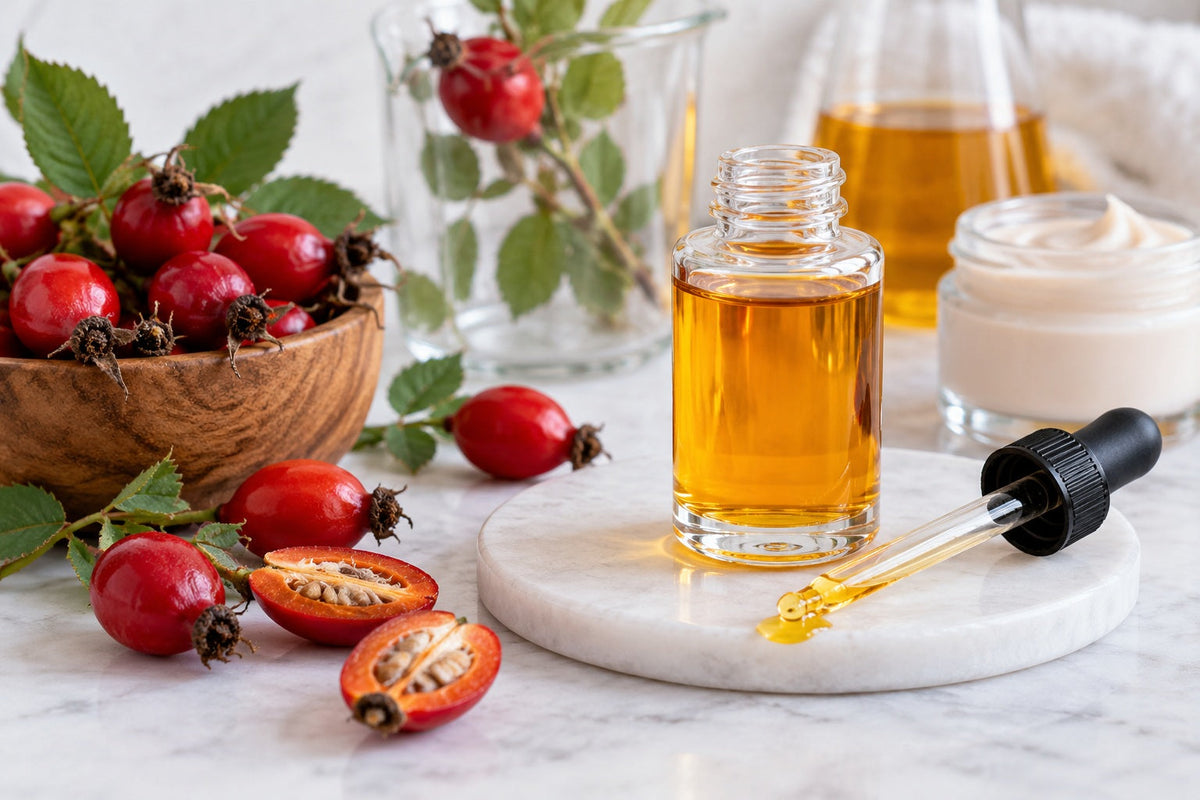
Rosehip oil is pressed from the seeds inside rose hips, the fruit that remains after a rose blooms — most commonly from Rosa canina or Rosa rubiginosa types, depending on source. It is typically cold-pressed, and it looks the part: a warm amber to orange-toned oil whose colour comes in part from naturally occurring carotenoid pigments, with a characteristic, earthy scent that is noticeably stronger than a neutral carrier's.
Its fatty acid profile is weighted toward linoleic and linolenic types — polyunsaturated fatty acids that give it a relatively light, fast-spreading feel for a natural oil, and also make it more sensitive to oxidation than a saturated or wax-ester oil. Both facts belong in the same sentence every time a founder considers it: the feel customers like and the fragility a formulator must plan around come from the same chemistry.
On the ingredient list it appears under its botanical oil name. Buy it as a documented cosmetic ingredient, with type, extraction method, and batch on file — "rosehip oil" from two suppliers can differ enough in colour, scent, and feel to change the finished product.
How it behaves in a formula
Light feel, unmistakable character
Unlike a neutral base oil, rosehip announces itself. Its colour tints a blend, its scent sits underneath fragrance rather than disappearing, and its finish feels drier and faster than richer oils such as avocado. That is why it is rarely the silent majority of a formula. It is the ingredient customers are meant to notice — in measured proportion.
Blending is the skill
Most well-built rosehip products blend it with a more stable backbone — for example a stable carrier or dry emollient base — so the finished oil keeps rosehip's character while gaining shelf resilience. Levels vary by product: a facial oil built around rosehip will carry far more than a cream using it as a supporting oil-phase ingredient. There is no honest universal percentage. The right level is the highest level your stability testing, scent balance, and colour consistency can support in the actual bottle you will sell.
Oxidation is the central handling problem
Heat, light, air, and time all work against a polyunsaturated oil. A rosehip formula needs the full set of defences working together: sound, fresh raw material on arrival; sensible antioxidant support appropriate to the formula; packaging that limits light and air exposure; and storage that does not leave bulk or finished stock warm and bright. No single defence replaces the others, and none replaces stability testing of the finished product over time.

Where rosehip oil earns its place
- Face oils and serums — its natural home: a product dosed in drops, used in a deliberate evening or morning routine, where its colour, scent, and light finish are part of the ritual customers are buying.
- Creams and lotions — as a supporting part of the oil phase, it contributes character and a lighter feel to an emulsion, balanced by more stable oils and the emulsion's own structure.
- Body oils — usually blended at a supporting level rather than as the whole base, where a stable carrier supplies most of the volume and rosehip supplies distinction.
- Sugar scrubs and emulsified scrubs — occasionally used where its character fits the scent and story, with the same oxidation planning, because a scrub jar opened repeatedly in a shower is a hard environment for any fragile oil.
Products where the oil would be invisible, heavily fragranced over, or stored hot are poor showcases for it. Rosehip rewards a product designed around it — and exposes one that added it as an afterthought.
Claims discipline: where founders get into trouble
Rosehip attracts exaggerated language because its traditional reputation is large. A cosmetic founder's job is to resist importing that reputation wholesale onto a bottle. Do not promise that a rosehip product will remove scars, erase spots, treat a skin condition, or deliver a drug-like result. Those are not cosmetic claims, and an honest oil does not need them.
What you can say, when the finished product supports it, lives in appearance and experience: a lightweight facial oil, a smooth and conditioned feel after application, skin feeling soft and looking cared for as part of a routine. Describe the oil truthfully — cold-pressed if it is, its source if documented — and let the ritual and the feel sell it.
Colour and scent variation deserve the same honesty internally. Set your acceptance range at sourcing, check each delivery against it, and do not widen it quietly because a batch is already paid for. A customer who reorders expects the second bottle to look and smell like the first.
How we approach it
At Simplicity Filling Systems, rosehip oil is treated as a character ingredient with a fragility plan: source and grade documented, colour and scent checked on arrival, blended over a stable base at a level proven in the real bottle, and stability-tested before scale. As a full turnkey partner, start to sold, we carry ingredient sourcing, manufacturing, bottling and packaging, fulfilment, and website and marketing support — across face oils, serums, creams, body oils, sugar scrubs, perfumes, body washes, massage oils, beach body oil, deodorant, supplements, and body butter. Small runs welcome, startups welcome, built to scale. Comparing quotes? Show us a comparable written quote — we'll match it or beat it.
Frequently asked questions
What is rosehip oil made from? It is pressed from the seeds inside rose hips, commonly from Rosa canina or Rosa rubiginosa types. Quality material is typically cold-pressed and documented by source and batch.
Why is rosehip oil orange or amber? Its warm colour comes in part from naturally occurring carotenoid pigments in the seeds. Colour depth varies by source and batch, which is why founders set an acceptance range and check deliveries against it.
Does rosehip oil feel heavy? For a natural oil it is generally experienced as relatively light and fast-spreading, with a drier finish than richer oils. The finished product's feel still depends on the whole blend and the level used.
Why is rosehip oil often blended instead of used alone? Its polyunsaturated profile makes it more oxidation-sensitive than stable carriers. Blending it over a more resilient base keeps its colour, scent, and feel character while giving the finished product better shelf behaviour — proven by stability testing, not assumed.
Can I say rosehip oil removes scars or spots? No. Those are treatment claims a cosmetic product should not make. Keep rosehip language in honest cosmetic terms: how the product feels, how skin feels and looks after use as part of a routine, and truthful facts about the oil itself.
The bottom line
Rosehip oil is worth building with precisely because it is not neutral: visible colour, real scent character, and a light finish customers seek out. Respect its fragility with a stable blend, protective packaging, and tested levels — and respect your customer with claims the product can honestly carry.
Thinking about a face oil or serum built around rosehip? Contact us and tell us the product, the role you want rosehip to play, and the bottle you have in mind. We will give you a straight answer on the blend, the packaging, and the run that proves it.
Simplicity Filling Systems — private-label and contract manufacturing in Sunrise, FL. GMP facility, 18+ years. Small runs welcome, startups welcome, built to scale.*
Ready for your number?
Run your specs through our Quote Builder for an instant online quote — or reach out for a custom quote.
More from News

PEG-150 Distearate: The Thickener Founders Add Cold, Dose by Hope — and Then Blame When the Wash Stays Thin
Sodium Cocoyl Isethionate: The Gentle Cleanser Founders Expect to Pour Like Water — and Then Blame When the Bar Turns Gritty
