
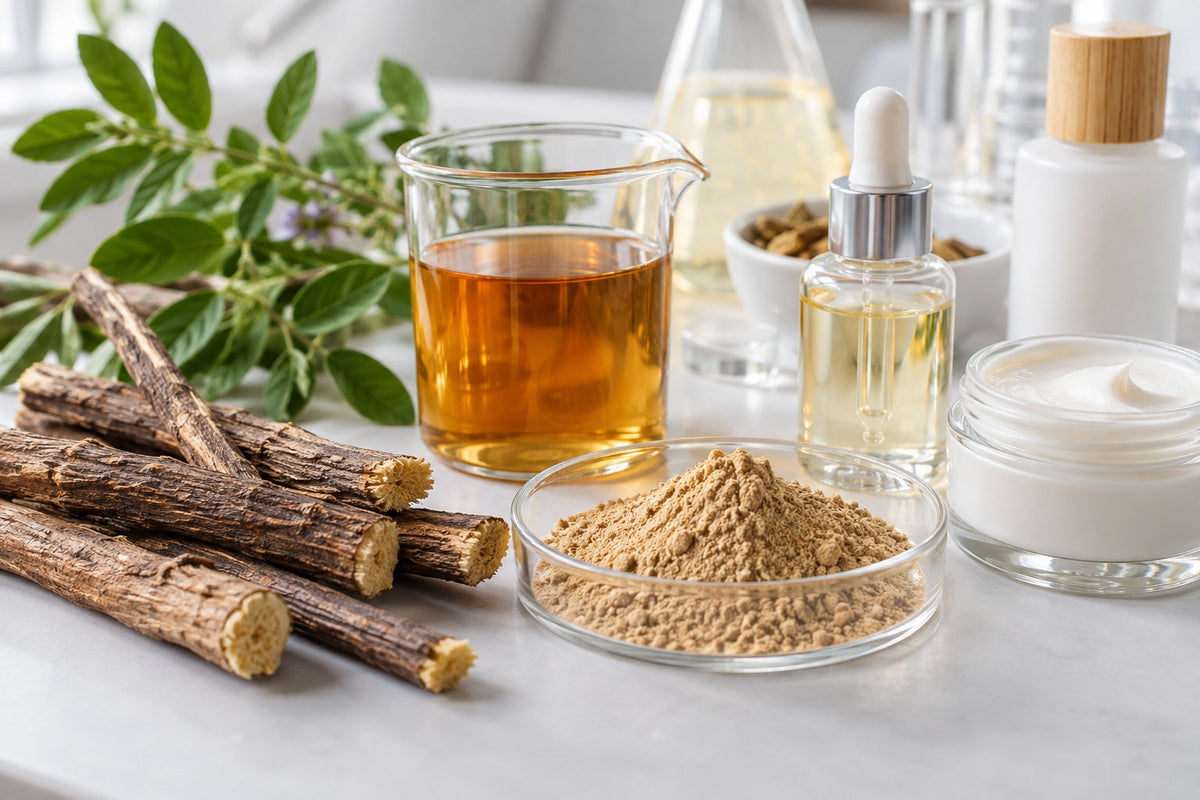
Licorice root extract launches usually start with a promise a founder cannot legally keep. Someone reads that licorice root extract in cosmetics is chosen for uneven-looking skin, rewrites that as a treatment claim on the front label, and then discovers — from a retailer, a platform, or an unhappy customer — that the product was never allowed to say it. The ingredient did not fail. The brief did. Licorice root extract is a useful botanical for even-looking, calm-feeling skincare when it is standardised, dosed with a reason, and described in honest cosmetic language.
Built that way, it earns a place in serums and creams customers use daily and judge slowly — by whether their complexion looks more even and settled over a routine, not by a miracle promised on day one.
What licorice root extract actually is
Licorice root extract comes from the root of Glycyrrhiza glabra. On a cosmetic label it appears as Glycyrrhiza Glabra (Licorice) Root Extract, though related licorice materials and isolated constituents exist under different names — and they are not interchangeable. A general root extract, a glabridin-rich material, and glycyrrhizin-focused material have different compositions, colours, solubilities, and costs.
Specify the exact material, its standardisation, carrier, and handling — then verify what arrives. "Licorice" on a purchase order is a nickname, not a specification.
Licorice root extract in cosmetics: what it actually does
It supports the even-looking complexion customers shop for
The honest cosmetic story is appearance: skin that looks more even in tone, looks less blotchy, and feels calm and comfortable. That is why founders choose licorice root extract for daily serums and creams aimed at a balanced, even look. It is not a licence to claim it removes dark spots, treats melasma or hyperpigmentation, lightens skin as a drug effect, or corrects a medical condition. Those claims cross into drug territory, invite platform and retailer action, and promise an outcome a cosmetic cannot be sold on. Keep the language to looks and feels — that vocabulary is durable, defensible, and still sells.
The material you buy decides colour, solubility, and feel
Licorice materials can bring colour to a formula — from pale straw to deeper amber-brown depending on the material and level — and that colour belongs in your design, not in a surprise at filling. Some forms dissolve cleanly in water or glycols; others need a solubiliser or belong in the water phase with careful dispersion. Add it at the stage and temperature the supplier specifies, because botanical extracts can be heat-sensitive and can shift with pH extremes. Test the finished system: a serum that was water-clear at the bench and turns hazy or darkens in its bottle has told you the material, level, or packaging was wrong for each other.
A botanical level still needs a reason
More extract is not automatically a stronger product. Past the level the material supports, founders buy colour, odour, tack, and instability without buying a better honest claim. Set the level from the specified material's guidance, the look you want, and the experience a customer will repeat — and hold that material and level to specification on every run, or the second batch will not match the sample customers reviewed.

Where licorice root extract earns its place
- Water-based face serums — its flagship format: a daily, even-look product where colour and clarity are designed, not discovered.
- Creams — in the water phase of an emulsion, for customers who prefer a cream format, filled and packaged through our production partners with the same stability discipline.
- Foaming face washes and cleansers — a supporting role in rinse-off formulas, with claims kept modest for a short-contact product.
- Body lotions in a routine — even-looking, comfortable-feel positioning across a larger daily routine, with the same claim discipline.
Stability, preservation, and packaging are not footnotes
A licorice serum is a water-containing product, so it needs a dedicated preservative system and preservative efficacy testing — a botanical story preserves nothing, and plant-derived materials give a formulator more reason, not less, to test properly. It needs stability testing for colour, odour, clarity, and pH in its real packaging, because licorice materials are among the first to show drift when light, heat, or an incompatible partner stresses the system. An opaque or light-protective pack is often a deliberate choice here, not a design compromise. Make it with test data in hand.
What to decide before you brief a run
Decide the exact material first — species, extract form, standardisation, carrier, and colour — and convert supplier guidance into a specification you can hold. Decide the level and the phase second, with solubility and addition temperature checked. Decide preservation, stability, and packaging third, as a single plan. Write the claims last, in even-look and comfortable-feel language only, with no spot-removal or treatment promises borrowed from articles the ingredient cannot carry as a cosmetic.
Keep reading
- Niacinamide in cosmetics: choosing a vitamin B3 level with a reason
- Bakuchiol in cosmetics: the plant-derived ingredient founders overclaim fastest
How we approach it
At Simplicity Filling Systems, a licorice root project starts with the exact material and its specification, then checks colour, solubility, preservation, and claims before any label is printed. As a full turnkey partner, start to sold, we carry ingredient sourcing, manufacturing, bottling and packaging, fulfillment, and website and marketing support — across perfumes, body washes, sugar scrubs, body oils, massage oils, beach body oil, deodorant, beard oil, and hair oil, with creams filled and packaged through our production partners. Small runs welcome, startups welcome, built to scale. Comparing quotes? Show us a comparable written quote — we'll match it or beat it.
Frequently asked questions
What is the INCI name for licorice root extract? Glycyrrhiza Glabra (Licorice) Root Extract is the common INCI name for the general root extract. Related licorice materials and isolated constituents carry different names and are not interchangeable — specify the exact material you buy.
Can licorice root extract remove dark spots or treat melasma? No. Those are drug claims. Cosmetic language covers appearance: skin that looks more even in tone, looks less blotchy, and feels calm and comfortable.
Why did my licorice serum turn darker or hazy? Colour and clarity drift usually trace to the material and level, light or heat exposure, pH, or an incompatible partner. Stability testing in the real packaging, with the material specified exactly, is how that is caught before launch.
How much licorice root extract should I use? A level set by the specified material's guidance, the colour and feel you want, and the honest appearance story — held to the same material and specification on every run. There is no honest universal percentage across different extract forms.
Does a licorice serum need preservative and stability testing? Yes. It is a water-containing product with a botanical material in it: a dedicated preservative system, preservative efficacy testing, and stability and packaging compatibility work are how the last bottle matches the approved sample.
The bottom line
Licorice root extract rewards founders who specify it like an ingredient, not a headline: the exact material, a level with a reason, colour and solubility designed in, and appearance claims it can honestly carry. That discipline is what turns a fashionable botanical into a product that survives retailer review and earns repeat orders.
Planning a licorice root serum or cream and want the material, level, and claims checked before the label is printed? Contact us and tell us about the product. We will give you a straight answer on the formula, the packaging, and the run that proves it.
Simplicity Filling Systems — private-label and contract manufacturing in Sunrise, FL. Small runs welcome, startups welcome, built to scale.
Ready for your number?
Run your specs through our Quote Builder for an instant online quote — or reach out for a custom quote.
More from News

PEG-150 Distearate: The Thickener Founders Add Cold, Dose by Hope — and Then Blame When the Wash Stays Thin
Sodium Cocoyl Isethionate: The Gentle Cleanser Founders Expect to Pour Like Water — and Then Blame When the Bar Turns Gritty
