
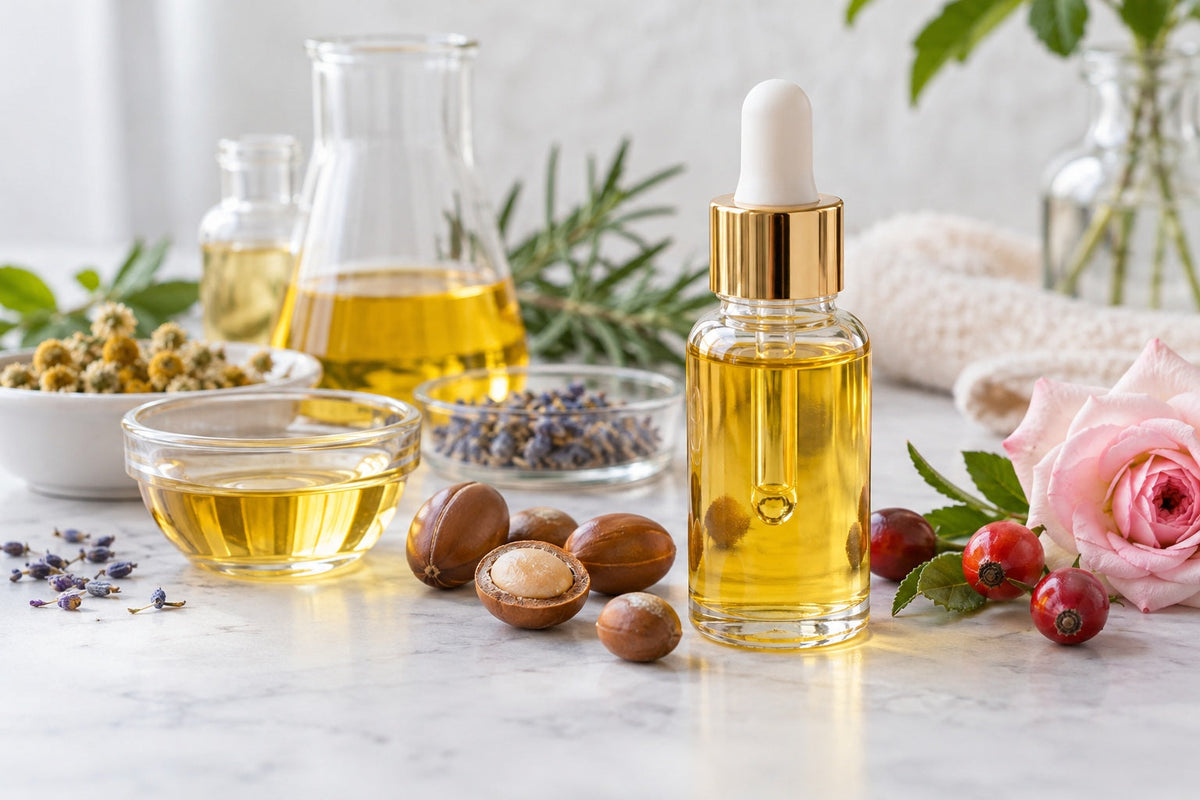
Ask skincare buyers about face oil and you will get two opposite stories: the product that completed a routine, and the greasy bottle abandoned after three uses. Same category, same shelf. The difference was the formulation choices nobody put on the front of the bottle.
That split is why face oils reward a careful founder: spread easily, absorb at the expected pace, smell clean, stay stable, arrive through a precise dropper. Miss one, and no ingredient list saves the reorder.
What a face oil actually has to do
A face oil is an oil-phase product — no water, no foam, no rinse. The customer applies a few drops, usually as a step in a routine: after cleansing, on its own, mixed with or layered alongside a cream, or as the finishing step at night. That simplicity is deceptive. With so few places to hide, every choice shows.
Feel is the formula
In most products, texture is one attribute among many. In a face oil, texture is nearly the whole experience. Customers judge:
- Spread — does it glide across the skin, or drag?
- Absorption pace — does it settle in within the time a routine allows, or sit on the surface while the customer waits?
- Finish — dry and satin, or slick and shiny? Neither is wrong in the abstract — but the finish has to match what your label and listing led the customer to expect.
- After-feel — minutes later, does the skin feel comfortable and soft to the touch, or coated?
Two oils with identical marketing language can land on opposite sides of those questions, because the carriers and proportions decide feel long before fragrance or color do. Sample the finished oil, on skin, in routine conditions — not just an ingredient deck.

Choosing the base: variety with a purpose
Face oils are built from carrier oils, esters, and supporting ingredients, each bringing a different weight, spread, and skin feel. Lighter, faster-spreading components pull a blend toward that dry, quick-settling finish many daytime users want. Richer, slower components pull it toward a nourishing night oil. Most good face oils are a deliberate blend, not a single oil in a pretty bottle — a single-ingredient oil can absolutely be a product, but then the honest positioning is simplicity itself, and the feel is whatever that one oil gives you, for better or worse.
Avoid building by reputation alone — stacking fashionable oils without a feel target for the blend. Start with the experience, blend to that target, then let the ingredient story tell the truth about what you built.
The quiet enemies: air, light, and time
Oils do not need the preservative system a water-based product needs, but they are not invincible. Oil-based formulas are vulnerable to oxidation — exposure to air, light, and heat over time can change scent, color, and feel, turning a clean-smelling oil into one customers describe as stale. The defenses are ordinary and effective when they are actually applied:
- Packaging that limits light and air — chosen for protection first, photography second.
- A dropper or closure that seals properly and doses cleanly, so the bottle is not left open on a counter through its whole life.
- Antioxidant support considered in the formula, as part of protecting the oils themselves.
- Stability checked in the finished bottle, over time — the oil the customer uses in month three should still be the oil you approved in month one.
A face oil that changes character mid-bottle does not get a second chance. Customers rarely write to explain oxidation to you. They just switch brands.
Where a face oil sits in a line
Face oils are natural routine partners. In front of them, a foaming face wash or body wash cleanses; behind them, a cream can layer for customers who want both. As a serum-adjacent step, an oil also gives a brand a premium-feeling, giftable product — small bottle, deliberate ritual, high perceived value — without requiring a sprawling catalog.
Positioning discipline matters too. A face oil is a cosmetic: keep claims in honest territory — feel, finish, appearance, routine — and out of treatment language entirely.
Where face oils go wrong
The pattern list is short because the product is simple: a blend built for its ingredient list instead of its feel; a heavy oil sold with lightweight language, so expectations and experience collide on first use; packaging chosen for the shelf photo that leaves the formula exposed; a dropper that leaks, sticks, or doses inconsistently; and no stability check in the finished package, so month three quietly undoes month one. Each is preventable at development stage, and each is disproportionately punished in a product this exposed.
How we approach it
At Simplicity Filling Systems, face oils are part of the oils family we manufacture and fill, alongside body oils, massage oils, beach body oil, and beard and hair oils — and within a wider range that includes perfumes, body washes, creams, sugar scrubs, deodorant, supplements, and body butter. Our approach starts with the feel target, blends to it, protects the result with packaging and a dropper proven with the actual oil, and tests the finished bottle over time. Small runs welcome, startups welcome, built to scale: prove the feel on a first run, earn the reorder, then extend the routine around it. When you compare quotes, use our price-match promise: show us a comparable written quote — we'll match it or beat it.
Frequently asked questions
What makes a face oil feel lightweight instead of greasy? The blend. Lighter, faster-spreading carrier oils and esters, in proportions chosen for a quicker-settling finish, are what customers experience as lightweight. It is a formulation decision, not a label adjective.
Is a single-ingredient face oil better than a blend? Neither is automatically better. A single oil offers simplicity and an honest, simple story, with the feel that one oil gives. A blend lets a formulator tune spread, absorption, and finish to a specific target. Choose based on the experience you intend to sell.
Do face oils need preservatives? A face oil contains no water, so it does not need the preservative system a water-based product requires. It does need protection against oxidation, sensible packaging, and stability testing in the finished bottle.
How should a face oil be packaged? In packaging that limits light and air exposure, with a dropper or closure that seals well and dispenses a controlled amount — tested with the actual oil, in the actual bottle, over time.
Can a face oil be a first product for a new brand? Yes, especially alongside a cleanser and a cream that complete the routine. Start with a run sized to prove feel and reorder, then scale on what customers validated.
The bottom line
A face oil has nowhere to hide, and that is its strength. Blend for a stated feel target, protect the formula from air and light, prove the dropper and the stability in the finished bottle, and say only what the oil honestly delivers. Do that, and lightweight stops being a word on your listing and becomes the word in your reviews.
Thinking about a face oil for your line? Contact us and tell us the feel you are aiming for. We will give you a straight answer on the blend, the bottle, and the run that proves it.
Simplicity Filling Systems — private-label and contract manufacturing in Sunrise, FL. GMP facility, 18+ years. Small runs welcome, startups welcome, built to scale.*
Ready for your number?
Run your specs through our Quote Builder for an instant online quote — or reach out for a custom quote.
More from News

PEG-150 Distearate: The Thickener Founders Add Cold, Dose by Hope — and Then Blame When the Wash Stays Thin
Sodium Cocoyl Isethionate: The Gentle Cleanser Founders Expect to Pour Like Water — and Then Blame When the Bar Turns Gritty
