
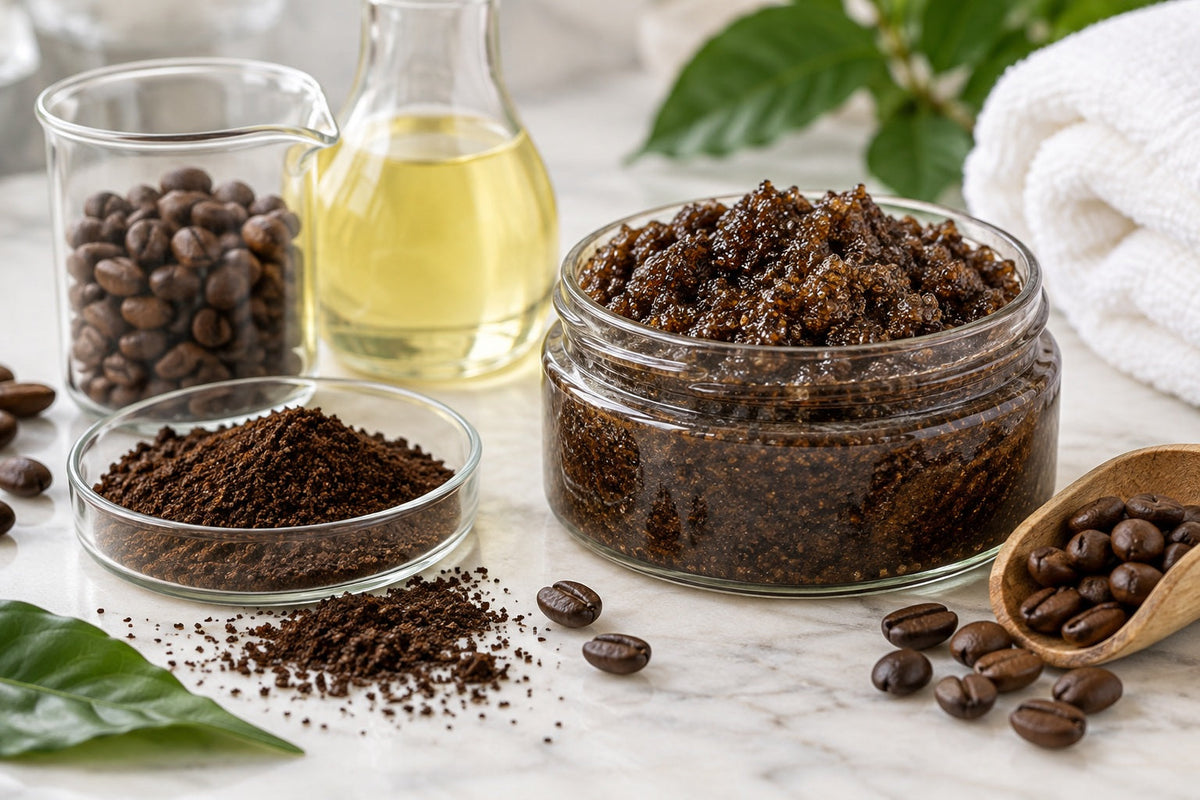
There is a specific disappointment every founder knows: the coffee scrub that looked rich in the jar and smelled like a fresh pot at the bench — and then turned to mud in the shower, stained the tub, and earned reviews that said "messy" more often than anything else. Coffee in body scrubs is one of the most gifted formats in body care, which is exactly why it is judged without mercy. Customers have used a good one, and they know it.
Built with the right grind, a stable base, and honest claims, a coffee scrub gives customers the wake-up polish they bought it for — and a shower they do not have to clean as part of the routine.
What coffee actually does in a scrub
In a body scrub, ground coffee is first an exfoliant particle: the material that does the polishing work as the customer massages the product over skin. On a label it appears as Coffea Arabica (Coffee) Seed Powder or the corresponding species name for the material you use — specify the species and form, and label from that specification. Coffee also brings colour, scent, and its own oils, so it is never a neutral ingredient.
The form decision comes first. Fresh dry grounds bring essentially no water load. Spent grounds — collected after brewing — are a wet ingredient carrying water and a microbial burden into your batch, not the same material with a better story. The two are different preservation projects. Choose deliberately, and write it into the specification.
Coffee in body scrubs: the decisions that decide the product
Grind size is the product — too fine is mud, too coarse is punishment
This is the lesson founders learn from returns if they do not learn it at the bench. Ground too fine, coffee disappears into the base and the scrub feels like scented mud. Ground too coarse or uneven, the same jar feels harsh, and the reviews use the word "sandpaper" — not as a compliment. The right grind is a specified particle range, checked lot to lot, because an unspecified grind drifts. Test the finished scrub the way a customer uses it: wet skin, real pressure, full rinse.
Water is the enemy you invite in — spent grounds and wet jars
A dry, oil-based coffee scrub has a real stability advantage, and founders throw it away in two ways: building on wet spent grounds without redesigning preservation around that water load, and packaging a wide-mouth jar that wet hands dip into every use. If your format invites water in, preservation has to account for real use, not bench use — and a water-containing scrub needs a dedicated preservative system and efficacy testing. Decide pack, in-use reality, and preservation as one system.
The mess is part of the product — design for the shower the customer actually has
Coffee is dark, its oils can leave residue, and a scrub that rinses poorly will colour grout and leave a ring. Customers forgive a coffee scrub a lot — they bought it for the coffee — but not a product that feels like it was never tested in a real shower. An emulsified design, rinsing cleaner and leaving skin conditioned rather than slick, is one honest answer. A traditional oil-based design is another — if the rinse is tested honestly. What fails is a formula approved from a jar photograph instead of a shower.
Caffeine claims: the line between cosmetic language and a cellulite promise
Coffee brings caffeine with it, and caffeine brings the most overclaimed copy in the category. A cosmetic scrub can honestly promise the experience: skin that feels smoother and more polished after use, and looks more even and refreshed. It cannot promise to break down fat, remove cellulite, slim the body, or detoxify anything. Those are drug claims, and they trade a product customers enjoy for copy a platform can reject. Write the morning-routine story — it is a strong story — and let the claims stay with feel and appearance.

Where coffee earns its place
- Dry oil-based body scrubs — the classic format, where grind, oil choice, and rinse decide the reviews.
- Emulsified body scrubs — for a cleaner rinse and lotion-like after-feel, with preservation designed for the system.
- Sugar and coffee scrubs — a combined design where both particle types are specified, not just listed.
Stability, scent, and packaging are not footnotes
Coffee's own oils can oxidise, so a coffee scrub needs stability testing for scent, colour, and feel in its real packaging — the fresh-pot smell at filling is not the smell at month six unless the formula protects it. Antioxidant thinking for the oil phase and a scent range checked lot to lot keep the tenth batch matching the first.
What to decide before you brief a run
Decide the grounds first — fresh dry or spent, species, and a specified grind range. Decide the base second: dry oil-based or emulsified, with preservation matched to in-use water exposure. Decide the rinse third, tested in a real shower. Write the claims last, with no cellulite or detox promises borrowed from caffeine's reputation.
Keep reading
- Cream & Sugar Coffee Scrub: the morning scrub that has to earn its place in the routine
- Sugar Scrubs: the exfoliant customers judge by rinse and after-feel
How we approach it
At Simplicity Filling Systems, a coffee scrub project starts with the grind, the grounds, and the base side by side, then checks rinse, preservation, and claims before any label is printed. As a full turnkey partner, start to sold, we carry ingredient sourcing, manufacturing, bottling and packaging, fulfillment, and website and marketing support — across perfumes, body washes, sugar scrubs, body oils, massage oils, beach body oil, deodorant, beard oil, and hair oil, with creams filled and packaged through our production partners. Small runs welcome, startups welcome, built to scale. Comparing quotes? Show us a comparable written quote — we'll match it or beat it.
Frequently asked questions
Fresh grounds or spent grounds — does it matter? Yes. Fresh dry grounds bring essentially no water load. Spent grounds bring water and a microbial burden, which changes the preservation design. They are different materials, not a silent swap.
Why does my coffee scrub feel like mud? The grind is the first suspect — too fine, and the coffee disappears into the base instead of polishing. Specify a particle range and test the finished scrub on wet skin.
Can a coffee scrub claim to reduce cellulite? No. Those are drug claims. Cosmetic language covers feel and appearance: skin that feels smoother and more polished after use.
Does a coffee scrub need a preservative? A truly dry scrub is a different case from a water-containing or emulsified scrub, which needs a dedicated preservative system and preservative efficacy testing. In-use water from wet hands belongs in that decision too.
Why did my coffee scrub lose its fresh scent? Coffee's own oils oxidise over time. Stability testing in the real packaging, antioxidant thinking for the oil phase, and a scent range checked lot to lot are how the smell at month six still matches the sample.
The bottom line
Coffee in body scrubs rewards founders who specify what others leave to chance: the grounds, the grind, the base, and a rinse tested in a real shower. That is how a morning ritual becomes a repeat purchase — instead of a dark jar and a stained tub.
Planning a coffee scrub and want the grind, base, and claims checked before the label is printed? Contact us and tell us about the product. We will give you a straight answer on the formula, the packaging, and the run that proves it.
Simplicity Filling Systems — private-label and contract manufacturing in Sunrise, FL. Small runs welcome, startups welcome, built to scale.
Ready for your number?
Run your specs through our Quote Builder for an instant online quote — or reach out for a custom quote.
More from News

PEG-150 Distearate: The Thickener Founders Add Cold, Dose by Hope — and Then Blame When the Wash Stays Thin
Sodium Cocoyl Isethionate: The Gentle Cleanser Founders Expect to Pour Like Water — and Then Blame When the Bar Turns Gritty
